



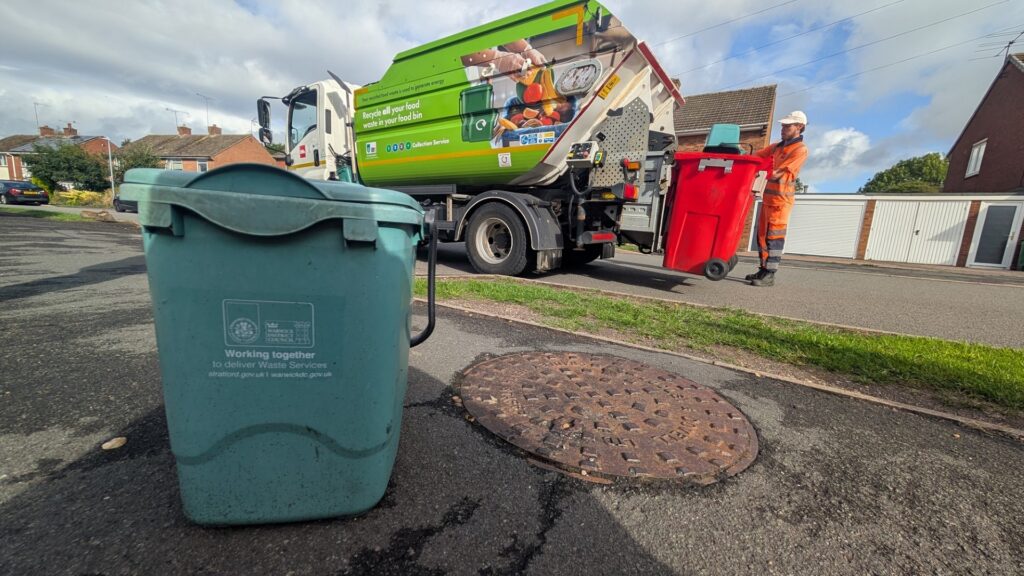
The regulation came into effect on 31 March 2025 for workplaces with ten or more employees.
Questions have also been raised over communication between operators and customers, the quality of data monitoring and food waste treatment capacity.
Smaller businesses in particular continue to face uncertainty over scope, expectations and timelines.
Introduced earlier this year, the regulations require all businesses, schools and hospitals in England to separate key materials – including paper and card, glass, plastics, metals and food waste – for recycling.
Compliance uneven but improving
Whilst progress towards compliance is visible, it remains uneven.
Carla Brian, Head of Partnerships at Biffa, commented: “Six months into Simpler Recycling for businesses, I think it’s still too early to say with confidence that all those who should be compliant are fully there yet.
“While many are making genuine efforts to meet the new requirements, there remains a lack of visibility and awareness among smaller businesses – particularly around what’s expected of them and whether they fall within scope from March this year or March 2027.”
Steve Mitchell, Managing Director – Commercial at Veolia UK, added: “Across the industry, we know that most businesses are, at the very least, broadly meeting Simpler Recycling regulations, but there are organisations who still remain outside of compliance.”
“The compressed rollout timeline has been the main challenge, leaving businesses and operators limited time to confirm customer needs, order the necessary containers and scale up resources for deliveries and collections.”
However, not all operators faced disruption during the transition.
A spokesperson for Grundon Waste Management reported that it experienced a smooth transition and that many of its customers were already in compliance prior to the regulations coming into force.
Waste operators step up engagement
For many waste management companies, the introduction of Simpler Recycling has meant operational changes across the board.
While large businesses are mostly aware of their obligations, smaller enterprises often rely on their waste contractor for guidance – a situation that has put more responsibility on service providers.
Brian continued: “In some cases, businesses have been hesitant to act on advice from commercial providers, worried it might be sales-driven rather than compliance-led.
“The private sector has really led on communications with customers, and that continues to be critical.”
Jacob Hayler, Executive Director of the ESA, explained: “Recycling and waste service operators report that they are having to do a lot of the heavy lifting when it comes to informing and engaging businesses about their new obligations under Simpler Recycling.
“Clear official guidance and communications campaign activity from Government would support the implementation of Simpler Recycling, followed by engagement activities to help our industry as we bring businesses up to speed.”
“Once the changes have bedded in, in order to maintain a level playing field, meaningful enforcement action will then need to be taken against those who fail to make the necessary changes.”
Dr Adam Read, Chief External Affairs and Sustainability Officer at Suez added: “We are actively engaging with our customers and were for six months leading up to the changes. However, relying on each contractor to inform and influence their own customers was only ever going to get us so far.
“Fundamentally, we can’t expect to be fully compliant six months in when Government hasn’t spread the word about Simpler Recycling more widely. We would do well to take our lead from Wales where the business recycling reforms were accompanied by a well-funded awareness raising and engagement campaign.”
Data, monitoring and enforcement
While most operators report growing compliance with Simpler Recycling, visibility of hard data remains limited.
David Gudgeon, Head of External Affairs at Reconomy Connect, commented: “At present, waste transfer notes, consignment notes and collections notes are primarily stored in paper form.
“However, the industry’s ability to track and analyse compliance will significantly improve with the rollout of Digital Waste Tracking.”
The EA confirmed it is working with Defra, local authorities and trade associations to collect data and monitor how businesses are adapting.
It said it “balances risk and seriousness against contextual mitigations” when responding to a breach, and in many cases will “provide advice and guidance before taking further action.”
A failure to comply with a notice could, however, lead to prosecution and a fine.
Food waste collections and AD capacity
The rollout of Simpler Recycling has also driven an increase in food waste tonnages from commercial collections.
Lee Dobinson, Chief Commercial Officer at Biotech4, explained: “There has been a marked increase in collection round vehicle tonnages, which suggests a positive take-up of the new legislation in the commercial sector.”
“There is still room for growth in this area, and we see the waste management collection companies working hard to capture that as tonnages continue to grow.”
Recent analysis from WRAP forecasted that separately collected food will increase by 100% by 2035.
Asked whether the anaerobic digestion (AD) sector is ready for the expected rise in feedstock, Dobinson said capacity should not be an issue: “As a whole, the AD sector is geared up and ready for this legislation change.
“We have been engaged with our feedstock providers over the last 18 months, planning ahead for these changes. So, we feel very positive about the year ahead.”
Household rollout around the corner
The next major phase of Simpler Recycling will see requirements extended to households from 2026, with flexible plastics due to follow in 2027.
Industry leaders say the commercial rollout is providing valuable lessons – particularly around engagement and education – that could inform how the household phase is implemented.
Read added: “Next April’s launch of Simpler Recycling for households is an opportunity to raise widespread awareness of the recycling reforms with a Government led national recycling campaign of the like not seen since WRAP’s Recycle Now over two decades ago.”
