



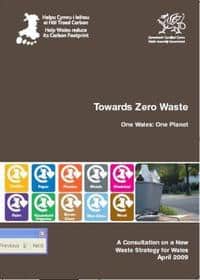
It also confirms plans for a 30% cap on municipal waste treated by energy from waste by 2025 in a bid to make Wales a “zero waste” society by 2050.
In order to help achieve high recycling rates, the Welsh Assembly has set out what are believed to be the first UK targets for sorting recyclables at source – requiring that 80% of recycling and composting should be collected source-separated from 2009/10 – either via the kerbside or from civic amenity and bring sites.
The strategy cited the influence of the revised EU Waste Framework Directive, which appears to favour the source-separation of materials where possible.
“To achieve a high recycling society we need to make sure enough supplies of our priority materials are separated out and that they are of a high quality,” it said.
“This is achieved most sustainably by ‘source separation' – where each material is collected separately – so that they are not contaminated,” it added.
Ambitious
The 70% recycling goal has already been labelled 'achievable' by the Welsh environment minister, Jane Davidson, (see letsrecycle.com story), and, announcing the strategy today, she claimed it went further than anything proposed elsewhere in the UK.
“Today we have proposed a new 70% target for recycling and composting all waste by 2025. I believe this is the most ambitious recycling plan among all the administrations of the UK,” she said.
Materials
As well as setting recycling targets, the strategy also proposes priority materials for waste minimisation efforts, including: for municipal waste, food waste, paper and plastic; for construction and demolition waste, wood, plastics, metals, insulation and gypsum and hazardous waste; and, for commercial and industrial waste, food waste, paper and card and chemicals.
And, the strategy targets a constant reduction in the amount of residual household waste produced per head, per annum, with a 295 kilogram goal set for 2012/13, falling to just 150kg by 2024/25.
For municipal waste, the strategy also proposes that, where waste is produced, it plans to concentrate on diverting paper, card and metals from landfill to recycling and diverting food waste from landfill to anaerobic digestion plants.
And, in terms of treatment options, including energy from waste, it stated: “We propose that residual waste will be phased out of landfill towards other forms of residual waste treatment. The Assembly Government's modelling focuses on high efficiency energy from waste treatments.”
“The landfilling of hazardous waste will be phased out in the medium term,” it added.
Infrastructure
To boost Wales' recycling rates, the document advocates the development of closed-loop recycling infrastructure, stating that: “Closed loop recycling is much better for the environment than open loop recycling.
“In some cases – for glass and plastic – open loop recycling can be more damaging to the environment,” it added.
And, it also calls for a greater use of eco-design, to ensure that products consume fewer resources, last longer, can be reused and are easier to separate and recycle.
Priority
The strategy also outlines proposals to develop 'sector plans' for what it says are “priority” areas, which are: municipal waste; waste industry, infrastructure and markets; construction and demolition; and, retail.
It explained that: “These plans will be customer facing delivery plan documents, which describe the role of the sector in delivering the strategy, lay out specific targets and policies, set out who will do what (by the sector, by others and by the Assembly Government) and be developed with sector representatives to make sure it can be achieved.”
Footprint
The strategy defines zero waste as a “100% resource-efficient economy where material flows are cyclical and everything is reused or recycled harmlessly back into society or nature”, where 'waste' as it is currently known ceases to exist.
As part of the plan to move to 'zero waste', the strategy outlproposes to reduce the country's 'ecological footprint' by combining the recycling and waste reduction efforts to achieve a target titled 'one Wales, one planet'.
It explained: “Within the lifetime of a generation we want to see Wales using only its fair share of the earth's resources, and where our ecological footprint is reduced to the global average availability of resources – 1.88 global hectares per person.
“To achieve this goal over a generation, we will need to reduce by two thirds the total resources we currently use to sustain our lifestyles,” it added.
The draft strategy is available for consultation until July 22 2009.

Subscribe for free