


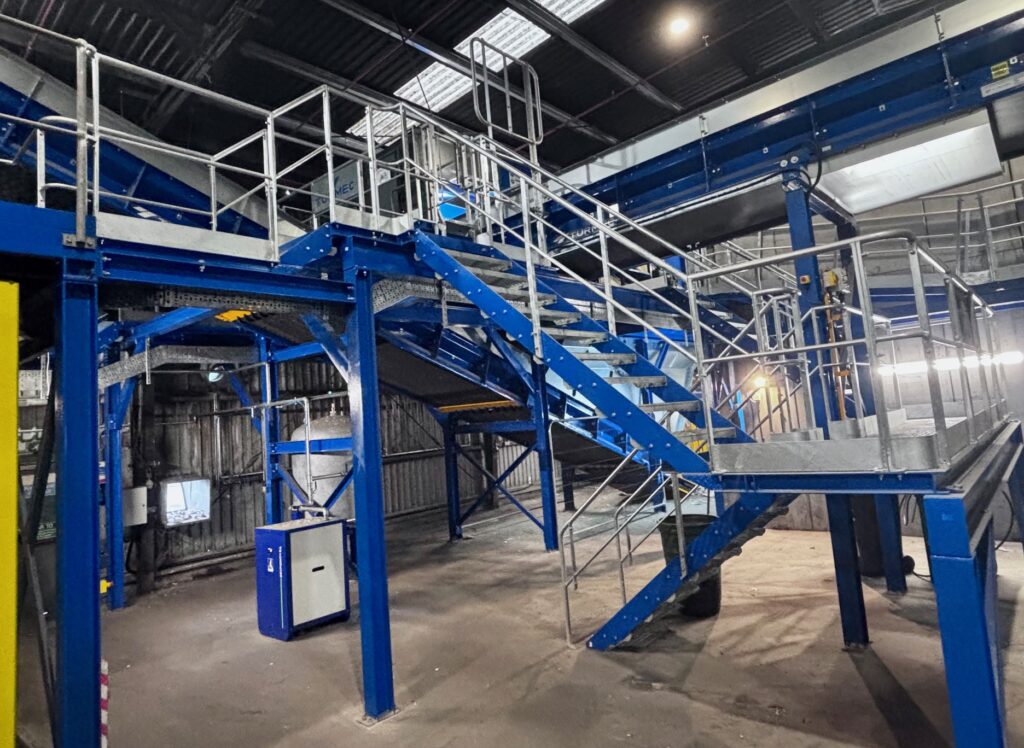
The site, which handles around 25,000 tonnes of kerbside paper and card annually, was forced to shut down in January 2025 after a battery ignited within the facility after being incorrectly discarded in household recycling.
Donald MacPhail, Chief Operating Officer of Treatment at Veolia UK, said: “The Beighton Materials Recovery Facility fire demonstrates the critical importance of the safe disposal of items like batteries, electrical items and vapes.
“Whilst we welcome the investment into improving the facility, the expenditure to repair fire damage could have been invested in other innovations to enhance Sheffield’s recycling services.”
Beighton MRF rebuilding
As part of the reconstruction, Veolia has installed a new metering feeder, an upgraded old corrugated cardboard (OCC) scree, and improved conveyor systems.
The company has also incorporated future-proofing measures into the redesign, allowing for later integration of near-infrared (NIR) sorting technology to further improve material separation.
Equipment previously housed below ground has been relocated to accessible above-ground areas, with the original floor openings now filled with concrete to create a safer working environment.
In addition, the facility will now operate with advanced fire detection and suppression systems featuring remote monitoring.
Veolia noted that these improvements will help protect both staff and critical infrastructure from the growing risks associated with dangerous waste placed in household bins.
January fire caused by household battery
The fire that shut down the Beighton MRF in January 2025 was believed to have been caused by a battery disposed of in standard kerbside recycling.
When crushed during collection or processing, batteries, vapes and small electrical devices can explode or ignite, producing fast-spreading fires and toxic smoke.
While no injuries were reported, the blaze caused significant damage to the site and forced Sheffield’s recycling operations to divert material elsewhere, an interruption that Veolia said could have been avoided through safer disposal habits.
MacPhail added: “We are grateful that no one was harmed and proactive steps are being taken to enhance the welfare of our employees, as this incident serves as an important reminder of potential risks associated with dangerous waste.
“The safety of our workers and the public remains our priority, which is why we promote our dangerous waste campaign to help communities understand the risks and learn proper recycling methods for electrical items.”
Fires linked to batteries continue to rise
The incident in Sheffield reflected a pattern increasingly seen across the waste and recycling sector, where fires linked to lithium-ion batteries and disposable vapes have become a significant safety concern.
With householders frequently discarding batteries and electrical items in general waste or recycling streams, waste operators nationwide have reported an uptick in vehicle fires, MRF shutdowns and costly infrastructure damage.
Figures from waste management company Biffa revealed last month that more than 840,000 vapes were discovered at just four of its waste sites – in Teesside, Walsall, Ipswich and North London – between June and September 2025.
Since June, Biffa has recorded more than 180 fires across its UK operations linked to batteries, many of them from vapes.
In September 2025, the Environmental Services Association (ESA) issued a stark warning that battery fires in the UK’s waste sector have reached “epidemic levels”, calling for urgent reform to mandate universal kerbside collections for waste batteries and small electricals.
