



Details of progress on the expansion at Templeborough, Rotherham were confirmed to letsrecycle.com this week by Tom Shields, the companys chief executive, who also pointed to the use of Sterefibre to grow energy crops to feed the biomass plant operated by Drax Power in North Yorkshire. And, the company is targeting Cardiff and London for the installation of more autoclaves for black bag waste.
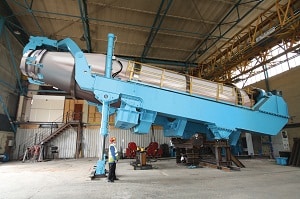
The expansion at the Sterecycle plant comes after a fatality at the site in January 2011 which led to the temporary closure of the facility after an explosion in a pressurised vessel.
Mr Shields said he could not comment on the incident as it was still under formal investigation but did note that the new autoclave was ordered long before the accident.
The 80,000 tonne-a-year capacity second generation autoclave, he said, was ordered in 2010, should be installed by Christmas 2011 and then be up-and-running in the first quarter of next year.
The 1.4 million order for the 80,000 tonne autoclave, and a further two to eventually replace the existing lines, was won by Sheffield-based Mayflower Engineering which has recently completed testing at its plant assembly workshops in Rotherham.
Mayflower Engineerings operations director, Glyn Hobson, said We are very pleased in how the design and development of the new rotating, pivoting, heated, pressure vessel has been undertaken in close collaboration with Sterecycles engineers to produce an autoclave to the highest construction and safety standards and capable of meeting Sterecycles operational demands at the Rotherham site for the next 25 years.
Rotherham
Currently Sterecycle has two autoclaves in Rotherham handling 100,000 tonnes of waste per annum, with 50,000 tonnes equivalent passing through each vessel.
Mr Shields said: The autoclaves are in effect, pressure cookers. We are the first in the UK to use them at a commercial scale for black bag waste. They are vessels that apply heat and pressure to kill bacteria and the purpose of our autoclave is to transform the material, particularly organics, paper and card into a biomass rich material which we call Sterefibre.
On the organics side, Mr Shield said: The key thing is to get the process right. Sterefibre is a freeflowing material that looks like compost it is a fibrous particulate which separates out and can be used for land restoration. The big breakthrough is that this year we have received approval from the Environment Agency to use it as a soil enhancer.
The Agency has accepted that the fibre we produce is low in contaminants. One reason is that we do not shred the incoming waste, so batteries for example are not shredded. This means the output is low in damaging materials and we dont have nickel and cadmium in it. And, we arent operating at incineration temperatures so no oxides are created.
Mr Shields said that the material has nutrients are at high levels and the company has worked with consultants ADAS on the organics side. We have been given a 2010 standard rules permit which enables us to use the material for agricultural use on land for growing non-food use crops. This means that it is ideal for the biofuel market for the growing of miscanthus.
The South Yorkshire region, he added, is already seeing the development of growing areas for miscanthus. There is demand from the Drax power station for its biomass plant and our organic material is ideal for use on poor quality land where miscanthus can grow.
Some 55,000 tonnes of organic material comes out of the plant and the volume is not significantly reduced, largely because steam is added to the process which counters any loss of moisture through heating.
Of the remaining material about 10% is removed as recyclables with a residue of about 30% at present which is landfilled.
Much of the material currently coming into the plant is under a contract with the BDR Partnership which covers the local authorities in Barnsley, Doncaster and Rotherham and the agreement has some headroom for Sterecycle to take in commercial waste from shops and offices.
Mr Shields said that the new autoclave is second generation. Without giving too much away, he explained that several features have been improved. There are process improvements to the way we mix the content of the autoclave and we have done a lot of work on the reactive transformation. We have also developed an improved way of transferring heat to the contents and then we get a more high-yield process.
New sites
Looking ahead, he confirmed that the company is intending to develop other facilities. Target cities include Cardiff and London. Sterecycle has land in both capitals with Cardiff the most likely development to get off the ground next.
But, Mr Shields says he hopes to get a project going in London. We are very interested in London. This is an attractive market and our plants work really well in close proximity to where the waste arises. There is no large stack and no public concerns about it.
Odour
Mr Shields acknowledged that there have been some odour issues at the Rotherham plant. He said: We continue to work to improve the control of odour. We have enclosed the plant with negative pressure inside the building along with other measures to address the inherent odours associated with waste.
Subscribe for free