



The Department for Environment, Food and Rural Affairs has published a guidance document setting out how businesses and organisations should adhere to the waste hierarchy.
The document, which was published alongside the Waste Review, is intended to counter the governments belief that many businesses are unaware of how significantly waste can impact them in a monetary sense.
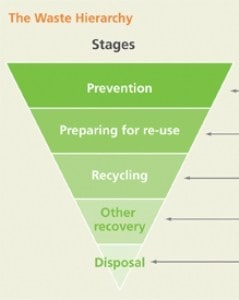
Prevention has emerged as a renewed focus of the government, with the Waste Review including a pledge to develop a Waste Prevention Plan by 2013.
Defra subsequently stated there were a million and one challenges to achieving adequate waste prevention in the UK (see letsrecycle.com story).
The core of the 14-page document is therefore aimed at making companies realise that adopting the waste hierarchy in day-to-day operations can make financial sense for businesses as well as public sector organisations.
The document is broken down into four sections: outlining what the waste hierarchy is; how it applies to a range of common materials and products; what businesses and public bodies need to do to comply; and, questions around dealing with waste in line with the hierarchy.
It also outlines ways in which waste prevention can save businesses and organisations money. These include suggestions to sell or donate unwanted items, cut out food waste, hire or lease electrical items rather than purchasing them and maximising the use of tyres, for example.
It suggests that companies or public bodies attempting to use the waste hierarchy effectively need to plot how they will apply the hierarchy, monitor it regularly, be aware of what and how much waste is being produced and take steps to segregate waste where possible.
Hierarchy
The order of the hierarchy follows Article 4 of the Revised Waste Framework Directive (rWFD), which sets out the five means of dealing with waste and is ranked in accordance with environmental impact. This goes from prevention at the top of the hierarchy through preparing for reuse, recycling, other recovery and finally disposal.
However, a summary document published alongside the guidance does include reference to Article 4(2) of the rWFD, which states that Member States can divert from the hierarchy on specific material streams. This has to be justified by a life cycle analysis.
For example, food waste is best used in wet or dry anaerobic digestion than other recovery options and recovery is a better alternative for lower grade wood than recycling.
Defra stresses that the guidance document does not contain information on hazardous waste, as that will be subject to a separate Strategy for Hazardous Waste Management in England. Defra is currently developing the document in conjunction with the Environment Agency.

Subscribe for free