



At the event, earlier this month, the new plant at the Image Business Park, Knowsley was opened by Graham Morgan, Knowsley council leader.
Addressing representatives from Contenur, which was founded in Spain in 1984, Councillor Morgan said he was “very proud that after an extensive search throughout the country, you have chosen Knowsley. These are challenging times and it’s a real sign of confidence for Knowsley and the wider Merseyside region.”
Wheeled bins
Cllr Morgan went on to emphasise the role that wheeled bins and other waste containers play in environmental terms, saying: “Manufacturing of waste system for a cleaner urban environment is very important for us all.”
Welcoming guests from around the UK, Iñigo Querejeta, chief executive of Contenur, explained how the company had identified growth trends in the UK but also the issue of Brexit.
Mr Querejeta said: “We considered should we stay with the status quo and see what happens or should we invest in the UK? We took the decision to invest in the UK – why, because we believe in the UK because it is a significant market, and for decades we have had very loyal customers and an excellent local team.”
Local community
The chief executive said he was proud to be at the opening of the factory and spoke of being a good industry for the local community. He declared that the company “will deliver circularity in our products – we are pleased to be able to use recycled containers in our new containers. We are providing good jobs and a circular activity. We are here to stay.”
Mr Querejeta also thanked Knowsley council “for all their help in the last few years”. And, he thanked Contenur’s customers for their patience, because commissioning new machinery is “very complex” and there had been some delays to the production side of the plant for reasons ranging from the pandemic, global raw material shortages and planning”.
Olympics
Neil Kavanagh, UK commercial director for Contenur, explained the company’s development in the UK which started in 1999 and had seen many highlights including securing the Olympics contract in 2012. Since then, there had been sustained growth, he explained, adding that the new factory gives the opportunity to meet much required market demand.
Mr Kavanagh said: “This long-term facility will be a big benefit to the UK. The market is growing, whether it is replacement bins, new roll-outs, food waste; the requirement continues to grow and with this plant we can provide additional capacity.”
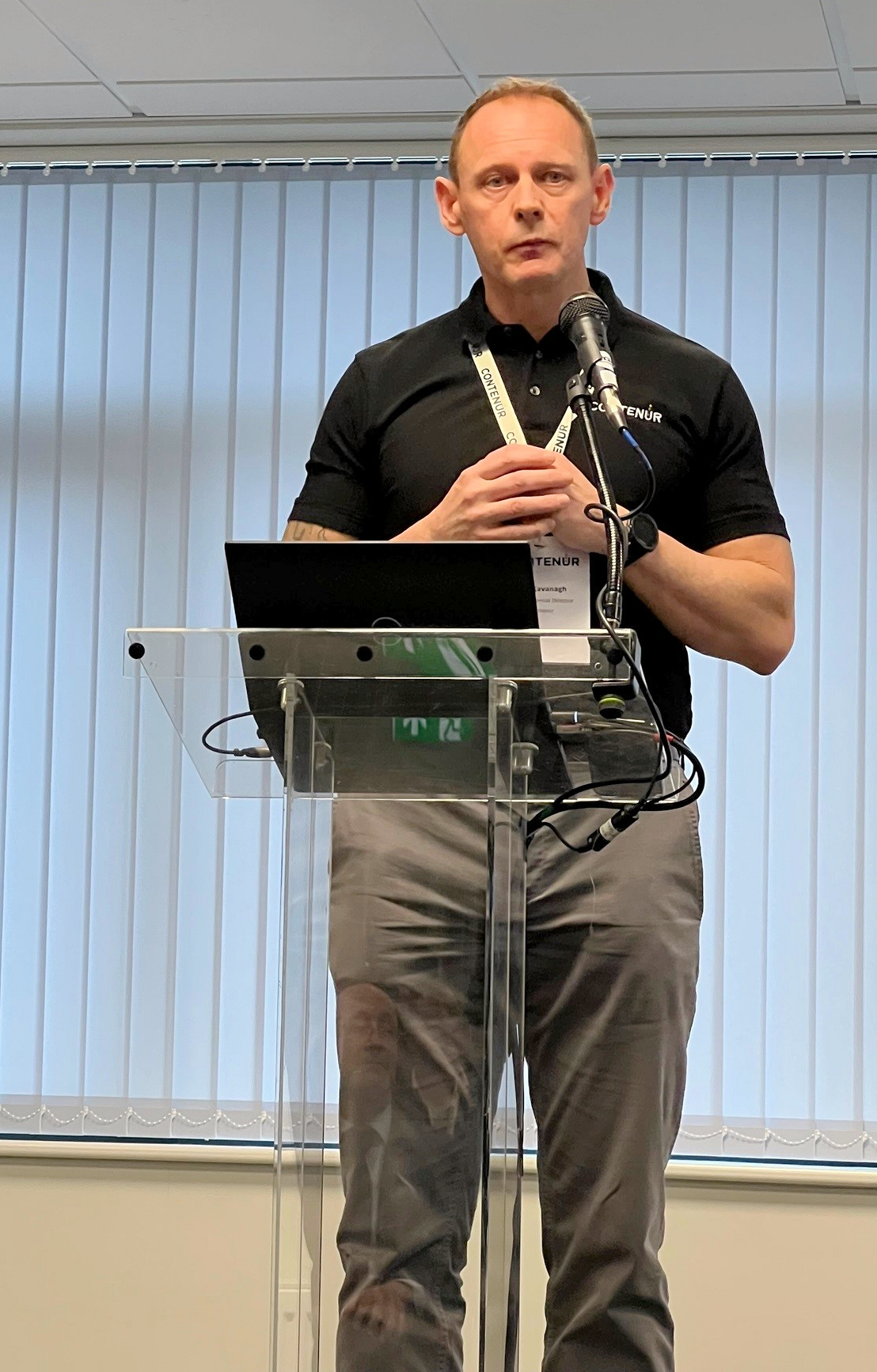
And he explained that as well as larger runs, Contenur likes to provide a bespoke service in terms of smaller production runs.
“We are aiming for a lead time of 2-4 weeks,” said Mr Kavanagh, although he conceded that is not quite happening currently due to some start-up issues. “In the short to medium term, we will be able to guarantee these short lead times compared to the industry average of six weeks.”
The large state-of-the-art structure which has been built for Contenur, houses three huge, sophisticated injection moulding machines to produce a range of containers. The company says the plant could produce the equivalent of 6,000 tonnes of products a year, representing 750,000 containers. Some of these will be exported to countries in northern Europe and further afield.
Recycled content
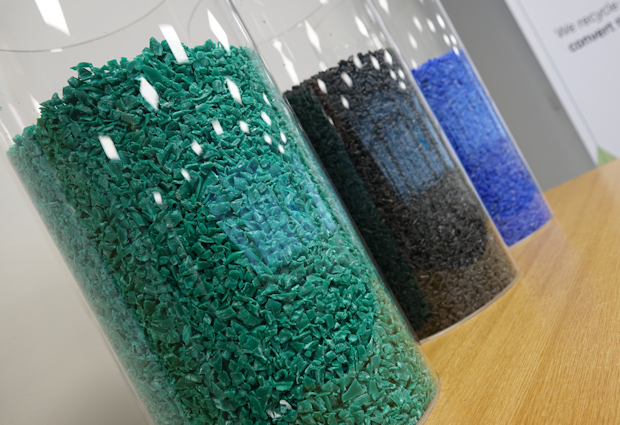
The bins have a recycled content either from production line scrap bins or from recycled granulate supplied by shredding partners external to Contenur. Typical recycled content ranges from 50-70%.
Quality certificates are in place and a testing area includes bin dropping (as an EN840 drop test) and also a hot ‘bath’ and freezer which bins can be put in for three days to heat or cool them. This latter process is seen as equivalent to ageing for many years, for assessment over their longevity in arrange of extreme conditions..
Subscribe for free