




Manufactured by Greenbottle Ltd, the milk bottles are made from recycled cardboard, with an inner sleeve of compostable plastic made from corn starch. They are produced on similar machines to those which make egg cartons.
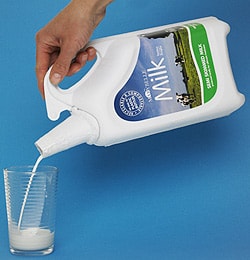 Suffolk dairy Marybell is supplying milk for the Lowestoft Asda store for a week-long trial |
During the one-week trial, customers at the Lowestoft branch of Asda are being asked to provide their comments to manufacturer Greenbottle.
Martin Myerscough, the inventor of the bottles, said today that the firm had already received 40 positive comments from consumers, and in the last two days the “bottles have sold out in an hour and a half”.
Explaining how the packaging works, Mr Myserscough told letsrecycle.com: “The biodegradable bag acts a barrier for the milk, and when you are finished with the carton you tear the bag out and put it in the general rubbish. The cardboard can go in with paper collections, in with garden waste or ideally it can be home composted.”
Mr Myerscough also said that the company is also looking at the possibilities of creating packaging for smoothies and fruit shakes. If used for these products, the inner plastic film would have to be adapted, since it would not be suitable for containing the more acidic fruit products.
Marybell Dairy, which has been providing the milk for the Asda Lowestoft trials, also supply milk to companies including Co-op. The company is looking to adopt the new packaging across their ranges.
Plastic mountain
Mr Myerscough, who is based in Framlingham, Suffolk, came up with the idea 18 months ago to tackle the “plastic mountain” ending up in Britain's landfills. “The idea came as a friend of mine runs a local landfill site and said that landfills are full of plastic milkbottles,” he said. “We shouldn't be using plastic in the first place. We are starting out with the wrong material. ”
He said the bottles are retailing at £1.20, the same price as the plastic alternative for the same brand of Marybell Milk.
The cardboard bottles are made with 'size', a special material that makes the product waterproof for forty eight hours. The inner sleeve of the Greenbottles take six weeks to biodegrade in landfill.
Greenbottle Ltd is looking into compostable packaging standards including EN1342 to see if they might be applicable. However the company recognises concerns about the biodegradable plastic “contaminating the composting process”, and has spoken to local composters who are facing “real problems with plastic in their process”.
Mr Myerscough said: “The plastic part could be composted, but it is a very thin bag. The cardboard could go in a paper or green waste collection and then people who don’t recycle can put it all into the general waste as it will biodegrade.”
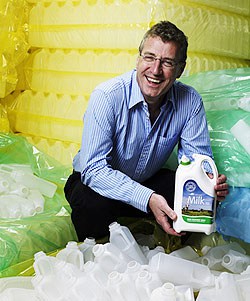 Martin Myerscough came up with the cardboard milk carton after a landfill operator told him about the amount of plastic being dumped |
Plastic recycling
The development of the alternative to plastic milk bottles comes despite the fact that plastic milk bottles are already being recycled from UK households, albeit with the HDPE plastic itself sent abroad for reprocessing.
Government-funded WRAP – the Waste and Resources Action Programme – is hopeful that reprocessing technology will be introduced soon in the UK to turn old plastic milk bottles back into new milk bottles in a “closed loop” process (see letsrecycle.com story).
WRAP was unavailable to comment today on the prospect of supermarkets replacing HDPE bottles with the new cardboard milk bottles. Asda itself is part of WRAP's retail scheme to cut packaging waste.
A spokeswoman for plastic bottle recycling organisation Recoup defended HDPE milk bottles as “proven to be fit for purpose and easily recycled”.
She said: “Over the past few years, there has been a significant growth in plastic bottle collection infrastructure as part of household recycling schemes. Survey 2006 data demonstrated that 17% of plastic bottles were collected for recycling and this figure is increasing.”
Local authority experts have warned that it could take “a lot of work” to get householders to sort the new cartons to remove the plastic film so the cardboard can be recycled.
Lee Marshall, chairman of Local Authority Recycling Advisory Committee, said: “If these were to come onto the market in a widespread manner – it would be vital to inform the public what they can and can't do with the product in terms of recycling. Given the current concern with material quality at we would want quality assurances before we start promoting them.”
Subscribe for free