
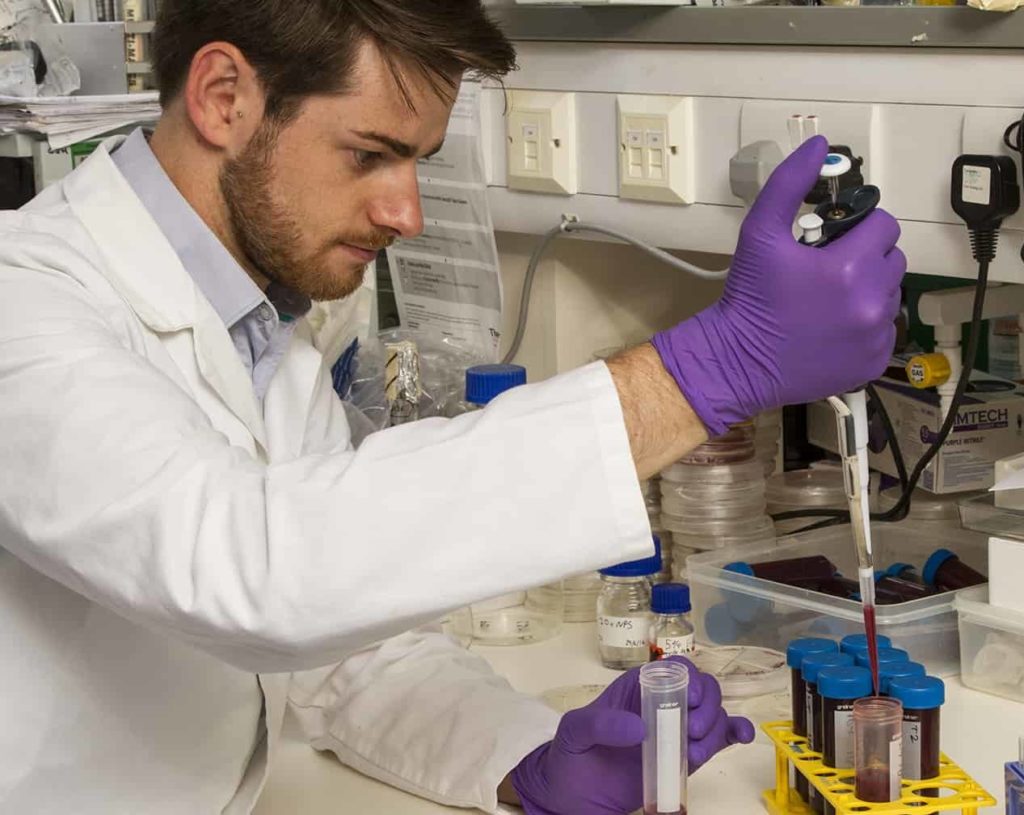
The project began back in 2009 when the Trust agreed to support Robert Pott as a doctoral student at Trinity Hall, one of the colleges at the University of Cambridge, to work with Professor John Dennis, of Cambridge’s Department of Chemical Engineering and Biotechnology.
Robert had graduated with First Class Honours in Chemical Engineering from the University of Cape Town, and his project with John Dennis was to study the use of a bacterium to break down waste glycerol from biodiesel production. Manufacture of biodiesel from plant oils generates a litre of glycerol as a by-product for every ten litres of biodiesel, but this glycerol is contaminated with soaps and other compounds, and is usually quite strongly alkaline, making it difficult to utilise.
Glycerol
Pott and Dennis opted to exploit a bacterium, with the scientific name Rhodopseudomonas palustris, to try to make useful products from the waste glycerol. This bacterium is widespread in mud and sediments (its name means ‘marshy’), but has been grown in the lab for many years.
It is photosynthetic, but it has a simpler form of photosynthesis than plants and algae, and is often a striking purple colour. Its photosynthetic capacity gives it an additional energy source to help in breaking chemicals down, and it is well known for its ability to grow on a wide range of molecules (and resist being poisoned by them).
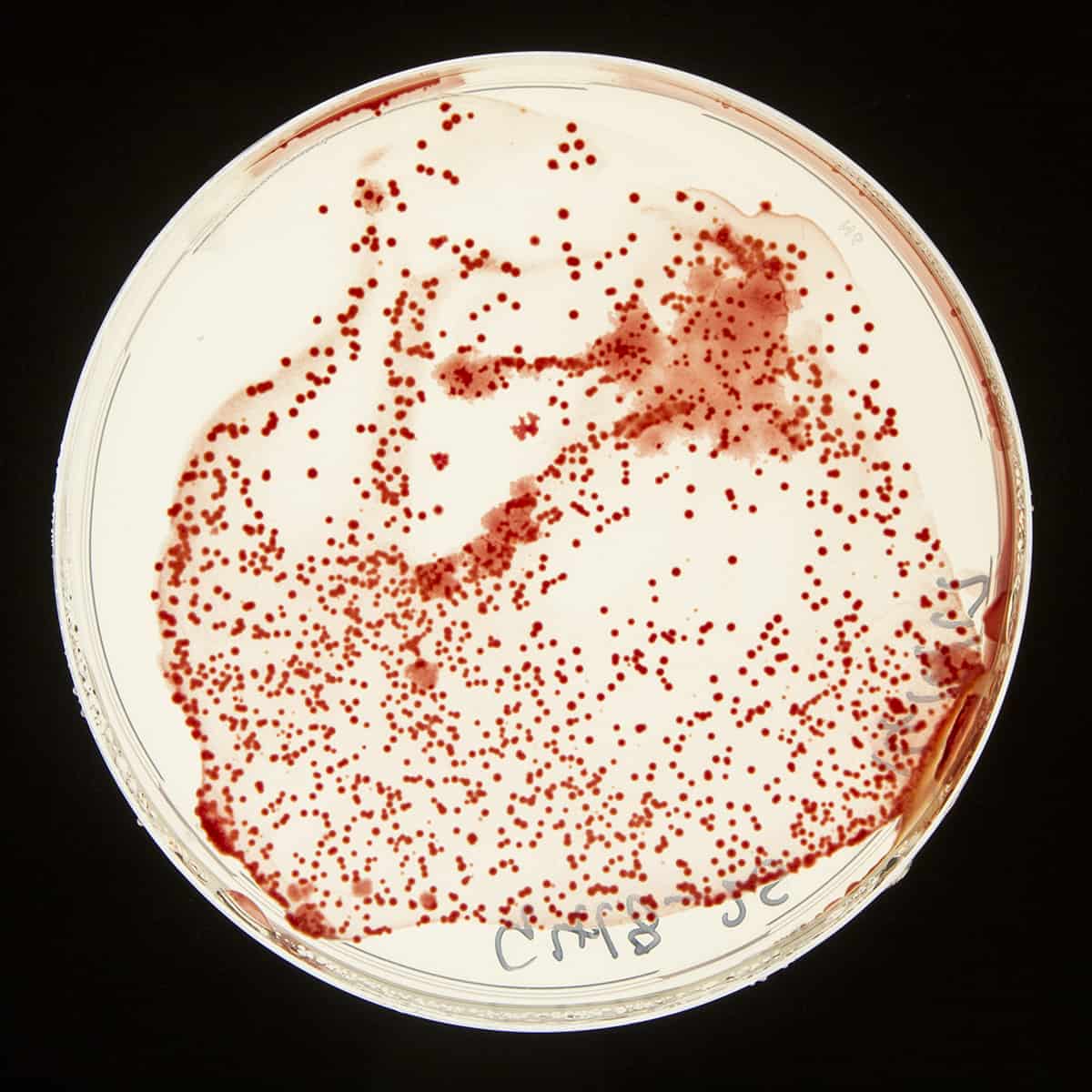
Importantly, it was already known to be able to metabolise glycerol and produce hydrogen, a commercially useful chemical. Pott and Dennis teamed up with Professor Christopher Howe, a microbiologist in Cambridge’s Department of Biochemistry, to exploit the metabolic capabilities of the organism. They developed simple conditions for optimising the ability of the bacterium to use waste glycerol, and showed that the hydrogen produced by the bacterium was remarkably pure.
Robert Pott was awarded his PhD as result of his work, followed by a prestigious Fellowship in the University of Cape Town, and then a Lectureship in the University of Stellenbosch, in South Africa. There he has established his own research team, and continues to work on the bioremediation of waste streams by this bacterium, working together with his colleagues back in Cambridge.
Modifying
The Trust has continued to develop the programme at Cambridge, broadening the waste streams being studied and how they can be used. This has led them to support work by Dr David Lea-Smith, a postdoctoral scientist working with Howe and Dennis. He had developed methods for genetically modifying the Rhodopseudomonas bacterium, which should allow the researchers to give it new metabolic capabilities – to produce chemicals it would not otherwise be able to make, and to improve yields.
The Trust funded him to develop this work further, and he has also carried out exciting research that has helped to show how the world’s oceans recover from accidental discharges of hydrocarbons (among the compounds found in oil spills) – and also that populations of bacteria in the oceans produce large amounts of hydrocarbons naturally (although not in the high concentrations that are so devastating in oil spills). David’s work in this area has aroused widespread interest, and his discoveries were covered by national and international media.
Thanks to the work done with the Trust’s support (and previously with support from Shell Global Solutions), David Lea-Smith has recently taken up a Lectureship at the University of East Anglia, Norwich. He will continue to collaborate with the Cambridge group, and help educate the next generation of microbial biotechnologists.
Techniques
The Trust has helped fund two additional PhD students in the Cambridge team, Jack Hervey and Clayton Rabideau. Jack Hervey has been studying the ability of the bacterium Rhodopseudomonas to grow on a wide range of different waste streams. He is using the techniques for genetic modification developed earlier in the project to introduce new genes into the bacterium to exploit features of those waste streams to make useful products. Clayton Rabideau is using waste materials to power devices for direct electricity production.
When organisms – from bacteria to humans – break down compounds, they generate electrons as a result. In our case the electrons are passed on to oxygen – which is why our life depends on oxygen – to produce water. This generates the energy that we need for life. Bacteria, if there is no oxygen around, can pass the electrons to an electrode, to generate an electric current.
This phenomenon has been used for some years in devices known as ‘microbial fuel cells’, which are the subject of intensive research worldwide and offer the exciting possibility of harvesting some of the energy locked up in waste streams as electricity rather than simply losing it. Much needs to be done, however, to improve the function of these devices, and this is the focus of Clayton Rabideau’s work.

ESAET’s primary objective in these projects is the training of talented individuals in the application of microbial biotechnology to waste processing – with the long-term goal of developing new ways for producing energy or useful chemicals from waste streams.
Outcomes
The Trustees, led by Roger Hewitt, recognise that the work may also generate valuable intellectual property, and they have carefully agreed arrangements with the University of Cambridge to protect and exploit worthwhile outcomes. Any financial returns from the work will be shared with the Trust to help further its charitable aims.
The scientists are delighted to be working with the Trust, on projects that combine world-class, curiosity-driven basic science with the possibility of generating truly useful applications in bioremediation of waste materials. They value the close contact with the Trustees, whose wealth of practical experience allows them too offer valuable input to the research programme. Importantly, the Trustees have the vision to support work that has something of a speculative, ‘blue-skies’, element to it.
More conventional sources for research funding in the UK, by contrast, tend to be much more conservative and risk-averse. In addition, the close interaction between the researchers and the small group of Trustees allows for a flexibility in development of the work, and in decision-making with regard to funding, that is difficult to find with conventional funders.
This is clearly a very attractive model for collaboration between industry and academia.
Authors
John Dennis is Professor of Chemical Reaction Engineering and Head of the Department of Chemical Engineering and Biotechnology in the University of Cambridge.
Christopher Howe is Professor of Plant and Microbial Biochemistry, and Deputy Head of the Department of Biochemistry at Cambridge.


Register for free to comment