

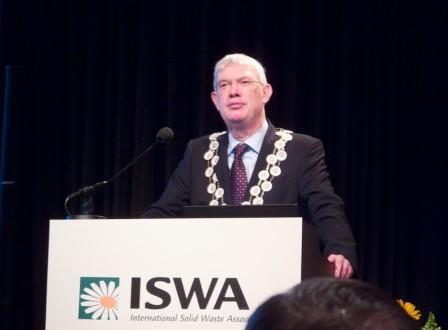
By failing to build as many energy from waste plants as proposed, the UK may have benefited from the pitfalls of over capacity, one of the world's top waste management experts has told letsrecycle.com.
The caution on overcapacity comes from Jeff Cooper, who has just been elected president of the worldwide International Solid Waste Association (ISWA).
Also a former president of the Chartered Institution of Wastes Management, Mr Cooper told letsrecycle.com: “Around the world it is fair to say Europe is leading the way in terms of sustainable management. Compared to the United States and Australia we have relied on legislation as the main instrument to drive progress in waste management. The US and Australia have been left to market forces with large landfill sites fed by road vehicles although gas from many of the sites is being utilised.”
And, the ISWA president continued: “While I believe Europe to be ahead you need to make the distinction between the leading part of Europe, where good standards are being achieved and countries are doing better, but some countries are doing worse by a long way. These poorer performers are bothered about it, for example we are having a beacon conference soon in Serbia where we will try to inculcate good practice with regard to landfill, recycling and recovering value from waste through energy recovery.”
And, Mr Cooper, who is known to support recycling and energy recovery, elaborated on his view that the UK can be said to have benefited from not having too many energy from waste plants in operation at the moment.
“It has been useful in having Kyoto targets and also funding mechanisms for projects. But, in some ways we have avoided the problems that the Germans and Dutch are facing, i.e. over-capacity as far as their energy from waste facilities are concerned. In the UK we have the possibility of other options in developing other sustainable sources of energy as well, such as biofuels rather than just incineration. As far as incinerators are concerned, Italy is now sending their non recyclable plastics, which have to be recovered, more cheaply to Germany.”
Mr Cooper said he would also not be surprised if some UK waste was sent to Europe.
Perhaps we should start thinking smaller scale even if we need some larger units in London
Jeff Cooper, ISWA
“UK waste could be sent to Europe but it is not something I would wish to encourage, but given the price the UK is charging this could happen. It may depend on when you are letting a contract and what is agreed.” But, Mr Cooper added: “If waste is sent abroad it would have to be presorted and sent for recovery.”
In terms of the UK market, the president said he felt the recent loss of some PFI projects from Defra's budgets “hasn't caused too much harm”
He commented:”These would have been complicated and we can now rely on the market force elements rather than the support of government. There is still money out there if you have good initiatives. If it means we are going for a series of smaller options that won't be a bad thing. Some of the smaller solutions, such as those proposed by New Earth Solutions, appear to be quite successful. Perhaps we should start thinking smaller scale even if we need some larger units in London.”
Anniversary
Expanding on the role of ISWA, Mr Cooper said that the organisation this year
celebrates its 40th anniversary. “ISWA represents professional waste managers, companies, countries, individuals, cities – a whole range of different people. It doesn't matter whether you are interested as an individual, as an online member or are in one of the big national bodies such as the Solid Waste Association of North America or CIWM, you can become a member of the organisation.”
He added: “ISWA's role is to develop best practice as far as waste and resource management is concerned. We have a number of outreach programmes, particular in developing and transition economies. But the West is important too. We are also working with global organisations including UNEP and the World Bank, the latter particularly in South America.
“At ISWA our policy is not there to dictate how things should be done, but to say that we would like this to be to the best possible standard. That's why we start with landfill and then we would say it is best to avoid landfill where appropriate. People should do much more in the way of recycling and waste management and where possible should used for energy recovery.”

Register for free to comment