

According to the latest government statistics released today (23 September 2026), England generated 7% less overall waste in 2024 at 178.1 million tonnes, down from 191.5 million tonnes in 2022.
Construction, demolition and excavation (CD&E), including dredging, accounted for the largest share of England’s waste, at 66%, while commercial and industrial (C&I) waste made up 17%. Household waste accounted for 12%.
Household waste on the up
The UK generated 26.2 million tonnes of waste from households in 2024, an increase of 1% on 2023.
England accounted for 21.9 million tonnes, or 84% of the UK total. Of this, 9.6 million tonnes was recycled, giving England a waste from households recycling rate of 43.8%.
Across the UK, 11.65 million tonnes of household waste was recycled in 2024, giving an overall rate of 44.5%.
The rate varied significantly between the four nations, with Wales recording the highest rate at 58.6%, followed by Northern Ireland at 50.1%. Scotland recorded 42.7%, while England’s rate stood at 43.8%.
Wales and Scotland both saw their recycling rates increase during the year, while England and Northern Ireland recorded small falls.
The rise in household waste in England was driven largely by residual waste. Total household waste generation increased by 218,000 tonnes, or 1%, with residual waste rising by 175,000 tonnes (1.4%).
Recycling increased by 53,000 tonnes (0.6%). Within this, dry recycling increased by 103,000 tonnes (1.9%), while organics fell by 50,000 tonnes (1.2%).
The figures include metals recovered and recycled from incinerator bottom ash (IBA), which Defra says adds around 0.9 percentage points to the overall UK recycling rate.
There was also a reduction in biodegradable municipal waste (BMW) sent to landfill. UK BMW sent to landfill fell from 5.3 million tonnes in 2023 to 4.9 million tonnes in 2024. England accounted for 4.2 million tonnes of this total, or 86%.
Steel has highest recycling rate of material streams
The latest figures showed that 73.2% of UK packaging waste was recycled in 2024.
A total of 11.15 million tonnes of packaging waste was recorded as arising, of which 8.15 million tonnes was recycled.
Paper and cardboard accounted for the largest quantity of packaging waste, at 4.84 million tonnes. Some 4.07 million tonnes was recycled, giving the material a recycling rate of 84.1%.
Glass was the next largest material, with 2.22 million tonnes arising and 1.76 million tonnes recycled, equivalent to a 79.1% recycling rate.
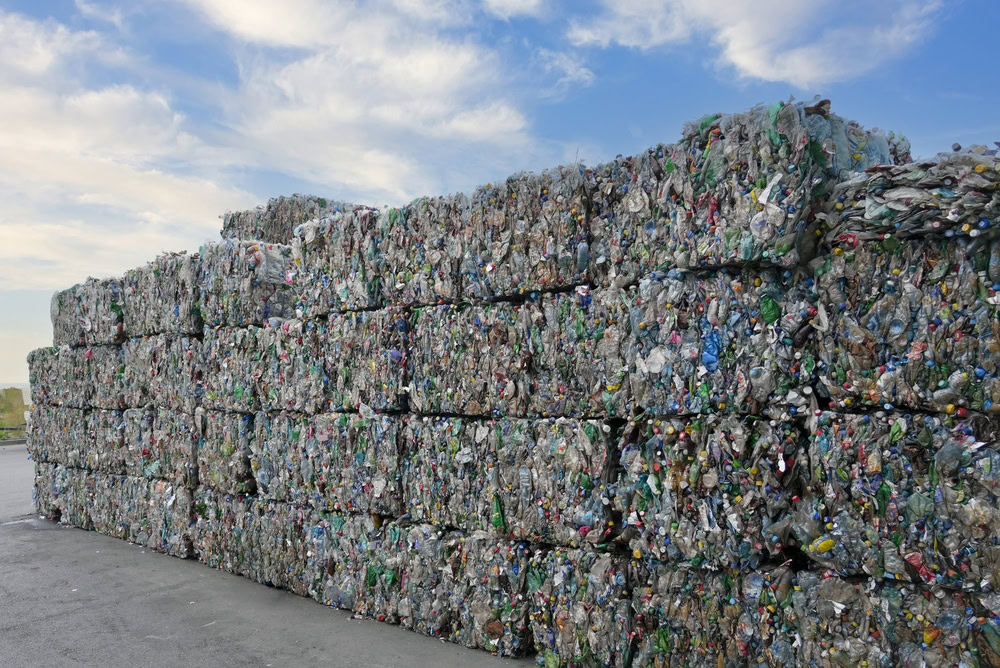
Plastic packaging accounted for 2.16 million tonnes, with 1.15 million tonnes recycled. Its recycling rate was 53.5%.
Wood packaging waste stood at 1.23 million tonnes, of which 634,000 tonnes was recycled, giving a recycling rate of 51.7%.
Metal packaging had a recycling rate of 78.7%, with 536,000 tonnes recycled from 682,000 tonnes arising. Within this, steel achieved a rate of 85.5%, while aluminium stood at 65.9%.
Provisional figures for 2025 show that the overall packaging recycling rate subsequently fell to 70.5%. Steel remained the highest-performing material at 88.5%, followed by paper and cardboard at 80.3% and glass at 75.1%. Plastic stood at 57.3%, while wood was at 43.7%.
Commercial and industrial waste
England’s commercial and industrial sectors generated an estimated 32 million tonnes of waste in 2024, down 3% from 32.9 million tonnes in 2023.
The commercial sector accounted for 22.7 million tonnes, while industrial waste stood at 9.3 million tonnes. More than two-thirds of C&I waste was therefore generated by commercial activities.
The latest figures continue a gradual decline in C&I waste generation since 2020, following a sharper fall between 2019 and 2020.
Construction, demolition and excavation was by far the largest source of waste in England in 2024.
The sector, including dredging, generated 118.2 million tonnes, down 10.5% from 132.1 million tonnes in 2022. It accounted for 66% of all waste generated in England during 2024.
Within the non-hazardous C&D waste stream, England generated an estimated 63.3 million tonnes in 2024, of which 60.3 million tonnes was recovered.
This gave a recovery rate of 95.3%, continuing a general upward trend from 92% in 2016.

Register for free to comment