

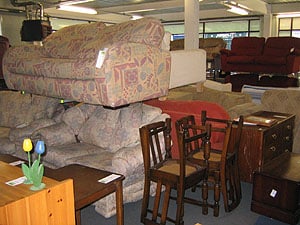

Compiled using data from research at Southampton University and information from consultants Resource Futures, the study compares how many reusable furniture items arise at civic amenity sites with how many are actually reused.
Now the FRN is appealing for local authorities to change their approach to bulky waste to provide low-cost furniture to those in poverty and divert waste from landfill.
Speaking at a conference on sustainable consumption at Sheffield Hallam University last week, FRN chief executive Paul Smith said: “Some councils have shown the way by introducing bulky re-use collections or setting up charity shops and workshops on civic amenity sites.
“We are calling on all local authorities and their waste management partners to adopt this approach,” he added.
Hierarchy
In the English Waste Strategy 2007, reuse is placed higher up the waste hierarchy than recycling (see letsrecycle.com story).
However, Mr Smith explained that reuse was still not being given priority because it did not count towards local authority recycling targets.
He said: “Reuse is currently not counted in local authority recycling targets which can discourage councils from doing it and we are talking to Defra and others about changing that.”
Mr Smith added that although reuse was promoted in the WEEE directive, many councils and producer compliance schemes were still sending all of their waste electronic equipment for recycling without considering reuse.
He said: “At the moment reuse is promoted in the WEEE directive and this is not being put into practice and we know that the vast majority of councils and producer compliance schemes are sending electronics for recycling without seeing if they can be reused. We are talking to the Environment Agency and Defra to make sure the rules are followed.”
Quality
Speaking at the Sheffield conference, Mr Hallam also called on the government to tax furniture made from low quality materials which could not be easily reused.
He remarked: “The FRN would like to see producer responsibility extended to these environmentally damaging goods with at least some of the revenue directed towards third sector re-use and recycling activities.”

Register for free to comment