


According to the Waste & Resources Action Programme (WRAP), only a small proportion of non-clothing textiles are currently collected for reuse and recycling and end markets for these are relatively underdeveloped.
However, the study entitled Demonstrating the viability of collecting non-clothing textiles, found that eight out of the ten business models analysed proved to be viable for the collector and cheaper than disposal via landfill.
The models assessed included direct collections from households and businesses, centre points such as household waste and recycling centres (HWRCs) as well as take-back schemes undertaken by reprocessors, councils and third sector organisations.
The study set out to investigate the different collection options being used for post-consumer non-clothing textiles from households and businesses in the UK. The work was undertaken as part of WRAPs Sustainable Clothing Action Plan (SCAP) which identified it as a key focus for its work in 2013 (see letsrecycle.com story).
An estimated 630,000 tonnes of this material enters the UK waste stream every year however under 20% of this is recycled or reused a stark contrast to clothing and household textiles of which almost 40% is reused or recycled, according to WRAP.
WRAP said: It is anticipated that as landfill tax rises, end markets for recycling and reuse grow, and reprocessing becomes more efficient and facilities more widespread, the viability of these business models and others will increase further.
The key findings included:
- Collecting non-clothing textiles for reuse or recycling can be cheaper than sending them to landfill. It may become cheaper still as landfill tax rises;
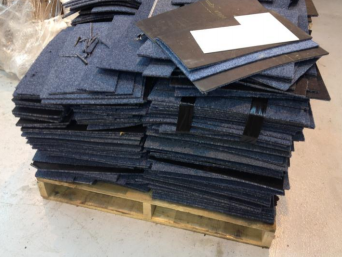
- There are a number of viable options for the re-use of carpet tiles, and the recycling of broadloom carpet and mattresses and collecting pillows can be cost neutral under the right conditions;
- Revenue from the sale of items for re-use and materials for recycling is too low to offset costs alone; commercial collectors rely on service charges to make services viable; local authorities and third sector organisations may charge for collections or in some cases benefit from grant funding to help establish services;
- There is a need for wider education of both consumers and businesses about the options for reusing/recycling non-clothing textiles.
Carpets

Of the products considered in the study, carpet is the only one where recycling and reuse has increased in recent years. In 2013, 21.4% of carpet was diverted from landfill, an increase from 16.5% the previous year (see letsrecycle.com story).
Reuse represents a key opportunity for carpet tiles, according to WRAP, as they can be collected, bulked-up and reused relatively easily. Similarly, carpet tiles can also be separated fairly easily for recycling. Broadloom carpet resents another challenge though, and while it can be shredded for use in insulation of equestrian surfacing products, closed loop recycling remains low. Energy recovery can be a viable option in this case as carpet has a high calorific value owing to its bitumen backing.
Mattresses
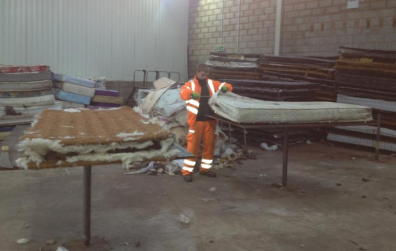
According to WRAP, 169,000 tonnes of mattresses arise as waste every year 25,000 tonnes of which are deconstructed to separate the steel springs from the textile cover and padding material. WRAP believes there is scope to increase this. Reuse remains low for mattresses, primarily due to hygiene concerns with only 100 tonnes reused every year.
Related Links
Opportunities for pillows and duvets also need to be better understood, WRAP said, as the majority are sent for disposal. The study found there is potential to reuse pillows from the hospitality sector due to the size of the institutions meaning sufficient quantities can be collected to make it viable.
WRAP concluded: More work is required to understand how the factors that influence collection viability interact to determine where more collections could be established. This work will involve engaging with key stakeholders and will be carried out during 2013/14.

Register for free to comment