


Viridor yesterday (March 1) officially opened a new £9 million “state-of-the-art” WEEE recycling facility on Merseyside on the site of its plant which was heavily damaged by fire in July 2008.
The St Helens facility was developed by German technology company MeWa to deal with up to 40,000 tonnes of waste electronic and electrical equipment a year, offering two lines housed in the same building – one to recycle small WEEE and one to handle fridges.
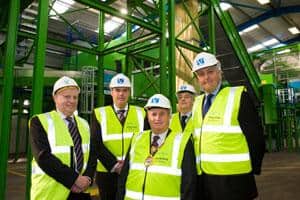
And, it allows the company, which also has a WEEE recycling facility at Perth in Scotland, to deal with the growing number of waste fridges containing pentane gases alongside those gassed with CFCs without shredding them.
Last year, Viridor joined other WEEE reprocessors in calling for legislation to ensure pentane fridges were treated to the same standards as other fridges due to concerns over the potential impact the gases could have on the environment (see letsrecycle.com story).
Recovery rates
Speaking at yesterday's opening, Viridor's managing director, Mike Hellings, highlighted the high recovery rates that the equipment installed in the new facility would allow the company to achieve.
“With clever deployment of technology and a skilled workforce we can recover 90% of that volume,” he said, adding that “it's part of a state-of-the-art recycling operation to have very high standards.”
Viridor expects the majority of the material being dealt with at the facility to come from household waste recycling centres, via the producer compliance schemes which need to fund the collection, treatment and recycling of WEEE to meet their members' obligations under the EU WEEE Directive.
Speaking to letsrecycle.com at the opening, the facility's manager, Simon Boyd, said that the plant was handling material from “all over the place”, such as Bedfordshire, the Isle of Man and the Republic of Ireland.

“Some plants have one line where they run one or another through it but we took the decision to have two lines,” he said. “The problem is if you have one line it's a balancing act.”
Machines
While the company has a more manual-oriented operation in an adjacent building which deals with recycling cathode ray tubes (CRTs) from TVs, the two lines of the new development feature specially developed MeWa 'Querstromzerspaner' machines.
The machines, which are a key part of both the fridge and small WEEE recycling processes, allow waste equipment to be broken up into metals and plastics without using a shredder, instead using chains to create a vortex which smashes items of WEEE against each other.
The equipment then passes through automatic and, in the case of small WEEE, manual sorting to recover specific fractions. For fridges this includes plastics, non-ferrous and ferrous metals and the foam which contains CFC and/or pentane gases.
For small WEEE, manual sorting after the Querstromzerspaner process allows Viridor to pick out material such as batteries, while four optical sorters are used to separate out plastics and also to deal with processor, or PC, boards, before the material goes through a further metals separation process.
Trevor Roberts, UK sales manager for MeWa, noted that the recycling efficiencies obtained by the fridge recycling process were actually “a bit higher” than the 90% cited by Viridor.
And, he also highlighted the benefits that the small WEEE process offered in terms of allowing the recovery of batteries and capacitors without them being cut open by a shredder, and the associated risks of hazardous materials escaping.

Register for free to comment