

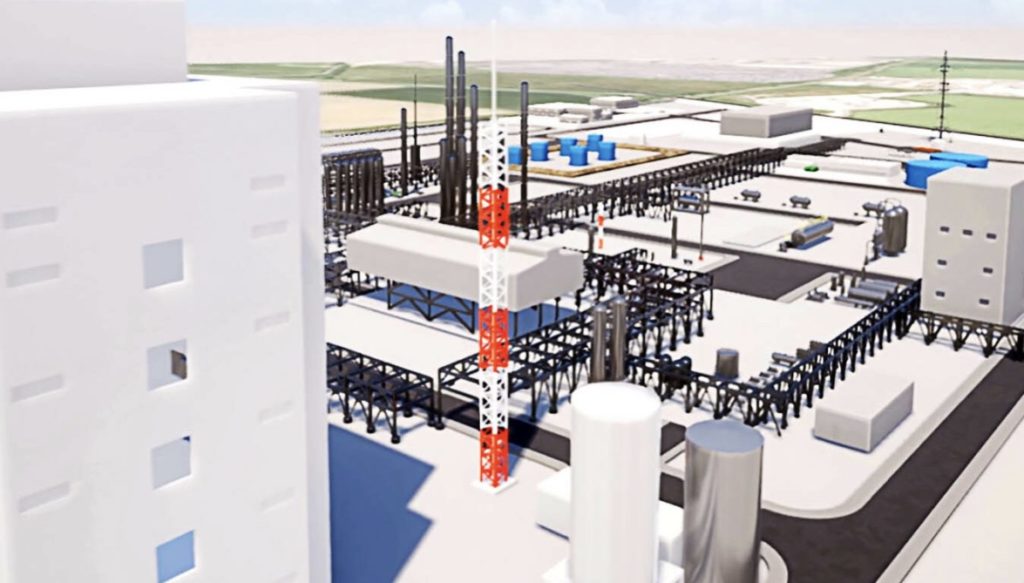
Velocys said that both grants came from the UK’s Department for Transport’s ‘advanced fuels fund’. The company explained that its subsidiary was awarded a grant of up to £27 million for its SAF project.
And, it received a separate grant of £2.5 million to contribute its technology to a UK e-fuels project in collaboration with partners.
SAF project
Velocys outlined that the SAF project is currently being developed under an existing ‘joint development agreement’ between Velocys and British Airways to deliver a commercial waste-to-SAF plant in Immingham, UK (see letsrecycle.com story).
The grant is set to allow Altalto Immingham to deliver the front-end engineering design (FEED) stage of the project. Velocys said that the grant funding will be distributed from December 2022 to March 2025 and is conditional upon receipt of private sector matched funding. Accordingly, Altalto Immingham has obtained letters of intent from several existing and potential partners, with the first tranche of private funding “due to be in place by April 2023”.
Velocys outlined that its cash contribution to the project over the two years from April 2023 is “not expected to exceed £8 million”, with this sum possibly reducing as additional investors are brought into the project.
In parallel with the completion of the FEED stage of the project, commercial agreements required to support the plant will be put in place, Velocys continued. These are expected to support the financial investment decision ahead of commencement of construction, which is to start in 2025. Commissioning is expected to begin in 2027.
Funding
Henrik Wareborn, CEO of Velocys, said that the company is “extremely pleased” to have been awarded the funding for the Altalto Immingham project as well as the e-fuels grant. He noted that the latter “reflects the capability of the Velocys technology to use different feedstocks, with the technology “enabling the production of synthetic liquid fuels such as SAF for the airline industry, from renewable power and CO2, as well as from sustainable waste and biomass”.

Register for free to comment