


However views within the sector as to the extent of the vary, with some recyclers saying the fall is “significant”, while others say it is only a small reduction – which will be rectified later, and others saying there is no reduction at all.
Quiet summer
Several recyclers pointed to a quiet start to the summer in terms of arisings, largely put down to the World Cup and warm weather, which then led to an “exceptionally” high amount of material on the market in August and into September, which is traditionally a time with higher material volumes anyway, especially as schools and university terms start.
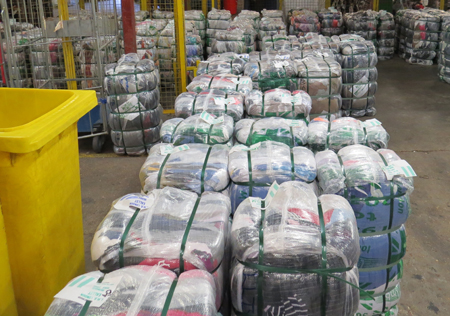
One large textiles recycler, explained to letsrecycle.com: “There was masses of volume in August, which I have never seen anything like before. People were accusing us of not emptying the textiles banks. We were, but the bins would be full again come the end of the day.
“This has proved difficult to move, but I think the real impact however will be in November, if recyclers still have a lot of material that they can’t get rid of by Christmas, the arisings afterwards will mean real problems for the market.”
The excess material, coupled with a decline in demand from export markets, has led some in the field to say they have stopped collecting from shops, where they are not tied into a contract, and have also forecast a possible market crash, as was seen earlier this decade.
Foreign markets
Demand for UK textiles is usually highest in markets in Eastern Europe and Africa, in particular western Africa. For the latter, elections can be a time of societal unrest, which has a knock-on effect on the trading market.
One textiles recycler reported having to stop exporting material to Nigeria, as both the February 2019 election there and legislative change meant he had to move to Benin, and accept a large price reduction.
This, mixed with trading implications tied with Brexit, meant the business was forced to drop prices by around 30-40%.
The recycler said: “Prices [for shop collections] have tumbled. There is plenty of material and it is getting very difficult to shift. People in end markets just don’t seem to want it anymore.”
“The pound has stabilised a bit and some other currencies are getting weaker, which means as a supplier we have to reduce our prices, or they cannot afford it. Myself, and many others, have had to stop moving material to Nigeria, as they have introduced legislation banning third-party payments, and have instead gone to Benin.”
Another however, said that his markets in Africa have given no indication of any issues.
Material quality
While the full implications of Brexit are so far undetermined until a potential deal is thrashed out, several textile recyclers say that even six months before the UK’s exit is triggered, its impact is being felt.

Alan Wheeler, director of the Textiles Recycling Association, said that while he doesn’t feel the market is about to crash, Brexit has meant a lack of workers for sorting material, which has led to a lower quality of material on the market.
He explained that while there is always a plethora of reasons as to why prices fall, an ongoing reason is a surplus of unsorted clothing.
“It is happening everywhere, all across the continent, people are saying there is simply too much of it which is unsorted,” he said.
Mr Wheeler added: “We’ve seen a retraction in sorting operations. There used to be 150 grades, which has now dropped, and that could show people are exporting lower grade stuff, and there is simply more available, which lowers the price.
“The reason we’re being told for this is that there is a shortage of staff available, a lot of them were EU workers, of which the number coming has slowed as a result of Brexit. However, this is one of many reasons. We are not at the crash level yet, however. I hope really that it is just part of a regular cycle, and soon the market will begin moving upwards again.”
Premature
This viewpoint was echoed by a former association president Ross Barry, of LM Barry, who explained that despite a price fall, talk of a crash similar to what was seen in 2013 is premature.
“Prices have fallen a bit, but I think something such as a cold winter would see them revert. I don’t think we are at crash level yet, and I don’t think we will be.”
He continued: “Everyone’s warehouse is full, so this means lower prices, which in this field can be sharp. I know charity shops have been told that prices are lowering, and some recyclers are saying they simply can’t collect if they are not tied into contracts.
“There is also competition with China, which is always growing in this field, people in Africa can get ultra-cheap Chinese textile goods, which aren’t always of quality but are cheap. I think anything such as a real cold winter would see prices revert to the rough level where they were. I think any talk of a crash is wrong.”
Flooding
Another UK-based textile recycler explained that he has seen a “rapid cooling” at the destination market, stating that buyers are gearing up for not buying as much as they used to.
He said that recyclers in Germany have said that the market there is certainly “on the brink”.
“There are parallels to 2013 definitely, there are more players in the market now than there was then, and Q1 and Q2 figures have seen a real ramping up of volume of material. We’ve dropped around £20 off our prices, which may well increase as time goes on.
“I think there is too much stock, particularly that of low quality, flooding from Asia into Africa and Eastern Europe. There is competition in traditional markets with EU countries and now China as well, people previously taking this are low looking for higher quality material than they were before, as they can get low quality stuff elsewhere.”

Register for free to comment