


The statistics published earlier today (17 October) show that Scotland recorded its lowest level of household waste generation since 2011 at 2.33 million tonnes.
However, the overall amount of household waste recycled between 2021 and 2022 decreased by 56,000 tonnes (5.2%) to 1.01 million tonnes, broadly in line with the reduction in household waste generated.
Elsewhere, the amount of Scottish household waste landfilled in 2022 was 585,000 tonnes, a decrease of 78,000 tonnes (11.7%) from 2021. This continues a long-term trend, with a reduction of 868,000 tonnes (59.7%) of household waste landfilled since 2011.
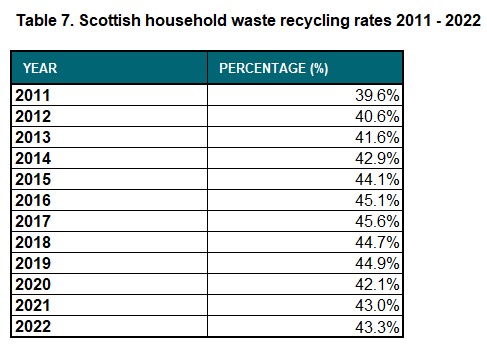
Recycling Rate
Among the material categories, paper and cardboard wastes took the lead, accounting for 27.6% of all waste recycled or reused in 2022. However, the report showed there was a 2.7% decline in the recycling or reuse of these materials between 2021 and 2022. The report states the decline aligns with the longer-term downward trend, which has seen a substantial 24.6% reduction in the recycling or reuse of paper and cardboard wastes since 2011.
Other categories witnessed shifts in their recycling and reuse trends. Notably, plastic wastes saw the most significant increase, with a 4.2% rise in 2022 compared to the previous year. Mixed and undifferentiated materials followed with a 3.7% increase. On the downside, glass wastes experienced a decrease of 8.1%, and construction and soils saw a reduction of 8.6% in recycling or reuse.
Scottish Borders council recorded the highest recycling rate at 57.3%, while Shetland Islands recorded the lowest at 20.7%.
Waste Reduction
The report reveals that the total amount of household waste generated in Scotland was recorded at 2.33 million tonnes. This figure marked a significant decrease of 148,000 tonnes, equivalent to a 6.0% drop, in comparison to the preceding year, 2021. This decline is particularly noteworthy, considering the previous trend that saw a 2.5% increase, equivalent to 61,000 tonnes, between 2019 and 2021.
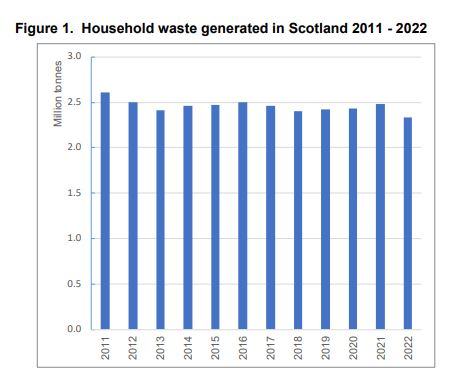
According to the report this can be attributed to the influence of COVID-19 restrictions. The initial increase in waste generation between 2019 and 2021 was linked to the surge in waste produced from home working and home improvement projects during the pandemic. This shift was then followed by a decrease in 2022, as COVID-19 restrictions eased, reducing such waste.
The amount of household waste generated in 2022 represents the lowest figure on record.

Register for free to comment