
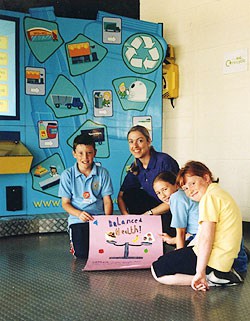
The programme, called “Glass Forever”, is targeted at schoolchildren aged from 7 to 11, and aims to encourage them to recycle glass and pressure their parents and families to do likewise.
 Glass Forever educational leader Joanne Hollins with children from Bramley Sunnyside school, Rotherham |
The companies told letsrecycle.com they have now reached over 72,000 children since 2001, through a specialist education centre at Rockware's Knottingley site in West Yorkshire, as well as two mobile teaching units.
Popularity
The popularity of the Glass Forever programme means it is now booked up by schools for six months in advance.
And, there are now plans to open an “advanced” Glass Forever education centre aimed at older students, community groups, local authorities and the business community.
Rockware Glass now uses over 230,000 tonnes of recycled glass at its factories in Knottingley, Doncaster, Worksop and Portland, collected by long-term partners Berryman.
But Rockware has capacity to use double this amount of recycled glass in its production process, which currently amounts to over 2.5 billion bottles and jars each year for brands including Coca-Cola, Smirnoff and Budweiser. It hopes to reach this level by 2008, the date of the next European recycling targets under the Packaging Directive.
Participation
Much of the extra collected glass must come from the household waste stream, but having councils developing new collection schemes is only part of the battle. Rockware and Berryman see the participation of residents as key to increasing glass recycling in the UK.
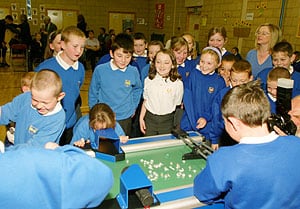 The miniature production line, showing how glass is recycled, is a hit with children |
Danny Barlow of Berryman said: “It does depend on the British public – a council can set up the most fantastic recycling system, but the public has to support it or there's no point. Education is so important in this.”
The Glass Forever programme is funded by money from the packaging producer responsibility system – via the sale of packaging waste recovery notes to packaging producers obligated to pay for the much-needed increase in recycling capacity.
The popularity among schools can be explained partly because it is completely free – not only for the use of three trained teachers, the education centre and mobile units, but also all transport to and from Rockware's Knottingley site. The centre also attracts groups of home-taught children.
Website
A wide range of activities and teachers' notes accompanying the programme can be downloaded from the Glass Forever website, and show how glass recycling can be included in the National Curriculum for English, Maths, Science, Geography, Design & Technology, History, Art – and even Music.
| Related links: |
The education centre also includes a miniature production line, which uses a mini-conveyor belt to demonstrate the different processes involved in glass recycling and reprocessing. The mobile units often visit schools as part of an integrated campaign involving the local authority, the waste management contractor or community groups.
Rockware's educational leader, Joanne Hollins, who has managed the project since its launch in 2000, said: “Working closely with the people who manage the recycling aspect of the waste stream is vital. All the evidence shows that messages aimed at primary age children will have the greatest effect on the community as a whole.”

Register for free to comment