

The findings come in the third set of quarterly data published today (November 11) on the WRAP Materials Facility online portal. Since October 2014 MRF operators receiving more than 1,000 tonnes of mixed waste each year have been required to report the quality of input and output material sorted at facilities (see letsrecycle.com story).
The MRF Regulations aim to bring ‘more transparency’ to the sorting and recycling of household waste in England and Wales.
The latest data covers the second quarter of 2015 (Q2) from April to June, for which 86 MRFs in England submitted data. In Wales, 11 MRFs notified the regulator (an increase of two from Q1 2015), with eight submitting data.
This equates to a total of 104 MRFs submitting data for Q2, from around 160 MRFs in England and Wales which are believed to meet the criteria to have to report their data.
But, according to WRAP, as many as 78 queries were raised on the returns for England, while queries were raised on all eight returns for Welsh MRFs.
Not all of these queries have been resolved, and while WRAP conceded that 86 total queries is “high”, it said this represents fewer queries raised by the regulators compared to previous quarters.
WRAP explained: “This is a slightly lower number of queries than previous quarters although is still a high number. This number of queries is to be expected as the reporting is still a relatively new requirement, with specific data required, and it will take time for the sampling and reporting processes to bed in.”
Indeed, as with the two previous quarterly publications of data, WRAP warns that “the reporting process is still relatively new so users should observe caution when attempting to draw conclusions from this data”.
England
Generally, the latest Q2 data for 2015 tends to show little change from the first two quarterly datasets published under the new MRF reporting regulations.
In England, the total tonnage of material entering MRFs in Q2 was 817,779 tonnes, which represents a fall of 58,965 tonnes from Q1, but still an increase of 28,384 tonnes from the first reporting quarter.
The average percentage of target material (by weight) received by responding MRFs in England in the second quarter was 86.5% – very similar to the previous quarter’s 86.8% (see letsrecycle.com story).
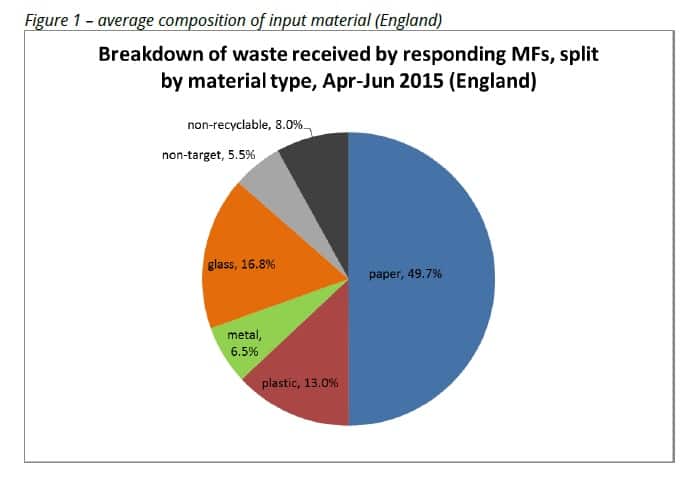
Of this target material, 49.7% was made up of paper, 13% was plastics, 6.5% was metals and 16.8% was glass – suggesting a slight increase in paper alongside a slight drop in plastics from the previous quarter.
Non target recyclable material accounted for 5.5%, while non-recyclable material made up 8% in Q2.
There was also little change in the average percentage of target material by weight in the output stream in England, which stood at 91.9% of higher in Q2 compared to 91.4% or higher for the previous quarter.
Wales
The average percentage of target material received by responding MRFs in the second quarter was 88.8% in Wales – again showing little fluctuation from 88.3% in Q1.
As before, the amount of paper making up this target material was slightly higher in Wales than in England at 52.6% – although this also shows a drop from the previous quarter’s 55.5% paper input.
Meanwhile, plastics (11.8%), metals (5.6%) and glass (17.8%) made up the remaining target material input in Q2 for Wales, with non-target recyclable material making up 5.8% and non-recyclable material accounting for 4.3%.
However, there was a more notable increase in the target material output percentage from 85.7% in the previous quarter to 89.1% or higher in the latest dataset.
For further debate on the impact of the MRF Regulations, join us at the MRF Best Practice 2015 Conference, click here for more details.

Register for free to comment