
Working with cement producer CEMEX, Suez (formerly SITA UK) are developing two new waste treatment facilities with the aim to transform commercial waste from across Birmingham into a high quality solid recovered fuel (SRF).
The residual waste material arriving at the site is primarily collected from commercial and industrial businesses across the region and would otherwise go to landfill. The product known as Climafuel is an alternative to coal, used at the CEMEX cement works in Rugby, thus saving landfill space and contributing substantially to the reduction of the use of fossil fuel in this energy intensive process. CEMEX is currently permitted to utilise up to 65 per cent of its fuel needs with this fuel.
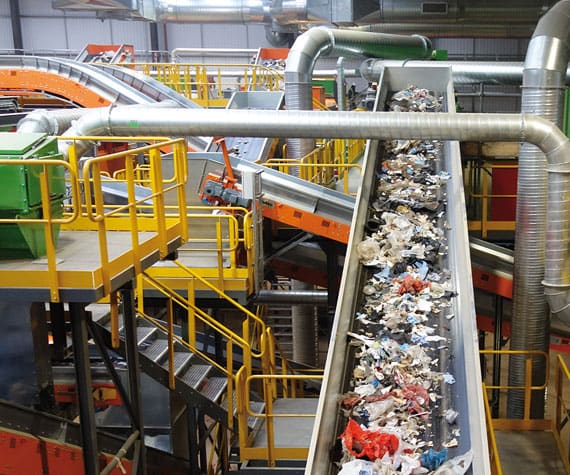
After having produced this fuel very successfully at the first SRF plant at Landor Street in Birmingham for the last couple of years, Suez commissioned SUTCO UK, the builder of the first SRF facility, as main contractor under competitive tender to design and build a second SRF facility in Rugby. This new £7 million facility includes several upgrades implementing the latest technology and will substantially increase Suez’ production capacity, then totalling around 250,000 tonnes of Climafuel a year between the two facilities.
Hybrid design
The key aim of the design was to provide Suez with a facility capable of meeting the stringent fuel specification of the cement kiln industry, which requires the fuel to have a maximum moisture content of 15%, a minimum calorific value of 17MJ/kg, and a maximum chlorine content of 0.8%. Suez also strived to extract valuable recyclables, targeting pre-dominantly ferrous and non-ferrous metals, but also paper and dense plastics at times when the fuel product allows the extraction of these materials.
SUTCO UK designed and built a hybrid solid recovered fuel facility, treating a mix of up to 240,000tpa of commercial and industrial (C&I) waste and municipal solid waste (MSW). By means of proven mechanical and optical separation the facility combines the recovery of a high quality SRF along with the recovery of metals, paper and dense plastics. The heart of the process are 4 Near Infra Red (NIR) units operating in two parallel lines, which first hit on paper, and then hit positively on SRF material.
This concept ensures to keep the moisture content of the fuel low and prevents any contraries, such as PVC and stainless steel, from entering the fuel. The added bonus of the plant is that the two first NIRs may target dense plastics instead of paper at times when the CV of the fuel spec is high and the moisture content low. The target material of the NIRs is controlled automatically by the fuel analyser, thus ensuring not only that the fuel, which has a confetti-like consistency, has the precise chemical composition and calorific value required by CEMEX, but also allowing to recover the best possible product outputs for the operator at all times.
Successful Partnership
“We are going to take out anything which can be recycled and then turn what’s left into a replacement fossil fuel”
Andy Hill
Suez

The contract was awarded in March 2014 with the mechanical installation starting in September 2014. Mechanical Completion was achieved in December 2014 and the plant started trial operation in January 2015 with full operation taking place since April 2015. After a series of tests the plant has now been fully taken over by the client.
The produced Climafuel is a registered trade mark and is only used to describe this alternative fuel used by CEMEX in the UK.
Suez UK Head of Alternative Fuels, Andy Hill, said: “The residual waste material that will be delivered to this facility would have gone to landfill but, instead, we are going to take out anything which can be recycled and then turn what’s left into a replacement fossil fuel – made to the exacting standards expected by our partners at CEMEX.
“We have been producing this fuel very successfully at our sister plant at Landor Street in Birmingham for the last couple of years, but this new facility implements the latest technology and will substantially increase our production capacity”.
This advanced SRF facility produces a more sustainable fuel to burn in cement kilns, reducing their reliance on fossil fuels while providing a long-term solution for the local community by diverting waste that cannot be recycled away from landfill.
Related links
SUTCO UK

Register for free to comment