



Europe clarifies battery collection licensing requirements
Conservative MEP Dr Caroline Jackson, who was recently rapporteur for the European Parliament on the Waste Framework Directive, obtained the clarification from the European Commission (EC), in a parliamentary answer, on the question of whether battery collection points would need a hazardous waste management licence.
Dr Jackson commented: “Not long ago an official from the UK Department of the Environment told me that head teachers would have to apply for such a licence if their school collected waste batteries. The European Commission, which I contacted, was amazed that anybody would contemplate this. Now I have obtained their official response in writing. If such a rule is introduced as the UK puts the batteries directive into force it is entirely the fault of the British, not the European, authorities. I hope common sense wins.”
South Gloucestershire awards planning for IVC to take Bristol's waste
South Gloucestershire council has given planning permission to New Earth Solutions to build a 50,000 tonne-a-year capacity in-vessel composting facility to take waste from Bristol city council.
The facility, which is to be built on the Hallen Industrial Estate in the South Gloucestershire district of Avon, is set to take 30,000 tonnes of waste a year from Bristol city council as part of a £32 million, 20-year composting contract that New Earth Solutions has with the local authority (see letsrecycle.com story). The additional 20,000 tonnes of capacity will be made available to other local authorities and businesses in the west of England. Dorset-based New Earth Solutions has been taking in green and food waste from Bristol city council for the past two year but has been forced to transport the waste 100 miles to its IVC facility in Poole.
Peter Mills, commercial director for New Earth Solutions, told letsrecycle.com: “We hope to be operating by the latter part of 2009.”
Buckinghamshire invites final tenders for £100 EfW contract
Buckinghamshire county council has invited the two remaining bidders for its energy-from-waste contract – Covanta Energy and Waste Recycling Group (WRG) – to submit final tenders as it begins the last stage of the procurement process.
The two bidders were shortlisted in August for the 25-year contract to build and operate an EfW facility for Buckinghamshire (see letsrecycle.com story). WRG are proposing to build at a landfill site at Calvert in the north of Buckinghamshire, while Covanta's proposed site is a disused clay pit in Bedfordshire. Final tenders are to be submitted by January 12, 2009 and the preferred bidder is expected to be announced towards the end of February 2009.
Martin Dickman, waste services manager at the council, said: “This has been a lengthy and very complex process, none the less we have been able to stay pretty much on schedule. There is still much for us and our advisers to consider before the preferred bidder is selected.”
SEPA cuts red tape in waste regulations
The Scottish Environment Protection Agency (SEPA) has announced further steps to reduce bureaucracy, while still ensuring high levels of environmental protection.
Changes have been put in place to how SEPA enforces three sets of regulations; the Producer Responsibility (Packaging Waste) Regulations, the Waste Electrical and Electronic Equipment (WEEE) Regulations and the Trans Frontier Shipment Regulations (TFS). They have been made as part of the environment watchdog's continuing drive to implement better regulation, helping companies to fulfil their environmental regulations and allowing more attention to be paid to those that do not.
SEPA's director of environmental protection and improvement, Colin Bayes, said: “An important part of SEPA's job is to help companies meet the requirements of the regulations they must follow. Sometimes however, there are aspects of the legislation that we are tasked with enforcing that increases bureaucracy without giving environmental benefit. Where appropriate, SEPA will take a position such that it will not enforce certain aspects of legislation. This does not mean that our dedication to environmental protection and improvement will suffer, in fact it will allow us to put more time and resources towards dealing with free-loaders and those who continue to flout the law.”
New device to prevent battery container theft
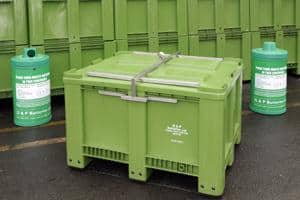
The company said the new specialist locking equipment, the BattBrace, which is designed to fit on G & P's own Battery Banks, helps securely lock the containers in which waste batteries are stored. It said the BattBrace is quick and easy to fit, keeps the lid firmly locked and cannot be removed with bolt cutters.
G & P managing director Michael Green explained: “The beauty of this device is its simplicity. It also enables customers to choose more flexible storage options, safe in the knowledge that they cannot be tampered with.”

Register for free to comment