

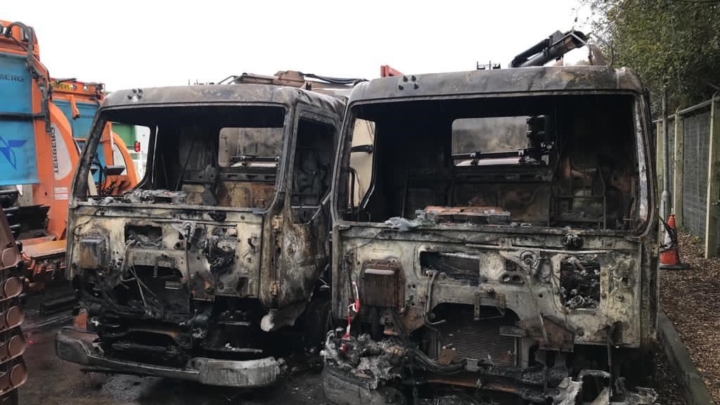
Other tips include parking vehicles engine-to-tail or keeping them in different parts of the yard if space is tight.
The advice follows a fire at Dorset council’s Crookhill depot in Chickerell on 15 November, which destroyed or heavily damaged 21 vehicles, 16 of which were refuse collection vehicles (RCVs) (see letsrecycle.com story). No injuries were recorded and the council says that, while the full costs are still unknown, its insurance arrangements cover it for such an incident.
Insurers from RBIG Corporate Risk Services, the Specialist Risk Group and Richard V Wallis who spoke with letsrecycle.com said that while the Dorset fire was “very unfortunate” and a “freak incident”, it provides an opportunity to companies and councils to review their practices.
They also said it was evident that Dorset had a “robust” disaster recovery plan in place, as it was able to respond so quickly.
Risk management
The insurers recommended several risk management measures councils and businesses could implement to protect parked vehicles. They advised:
- Spacing vehicles out and parking with a several metre gap if room allows. This was described as “strategic parking”, with one insurer recommending a six-metre distance. Vehicles should be parked engine-to-tail or kept in different parts of the yard if space is tight.
- Considering the installation of video smoke and flame detection systems covering the area where vehicles are parked, linked to a fire alarm monitoring service.
- Checking and servicing the vehicle electrical system including the battery. Infrared thermography may be a tool that could help an experienced auto-electrician detect faults in electrical circuits that may otherwise go undetected.
- Installing automatic vehicle fire suppression systems, particularly for those operating high value or hard-to-replace vehicles or plant.
- Constructing fire break walls to avoid an accumulation risk. One insurer warned this was not always practical due to site constraints.
- Taking precautions to minimise the risk of an arson attack. Perimeter security should be sound. Good lighting is an important deterrent. CCTV installation may be a wise investment. Parking areas need to be kept clear of combustible materials and waste, such as pallets that could be used by an arsonist as fuel.
‘Freak incident’
Stephen Hodgson is commercial director at RBIG, an insurance agency based in Greater Manchester. He described the circumstances in which Dorset lost its fleet as “exceptionally unusual”.
“It is sensible for waste operators to review their own disaster recovery plan”
Mr Hodgson told letsrecycle.com: “Loss of a single specialist vehicle due to accident or fire damage is costly, although the loss of multiple units or entire fleet in an accumulation event would inevitably lead to significant operating issues and potential dire consequences.
“For this reason, it is sensible for waste operators to review their own disaster recovery plan to ensure it captures such a scenario, albeit a rare event.”
Crookhill fire
Following the fire, waste collections were disrupted in the Weymouth and Portland areas but resumed after Dorset council hired temporary waste collection vehicles. The council also lost vehicles based at Ferndown and Wareham which were in the Crookhill depot for servicing.
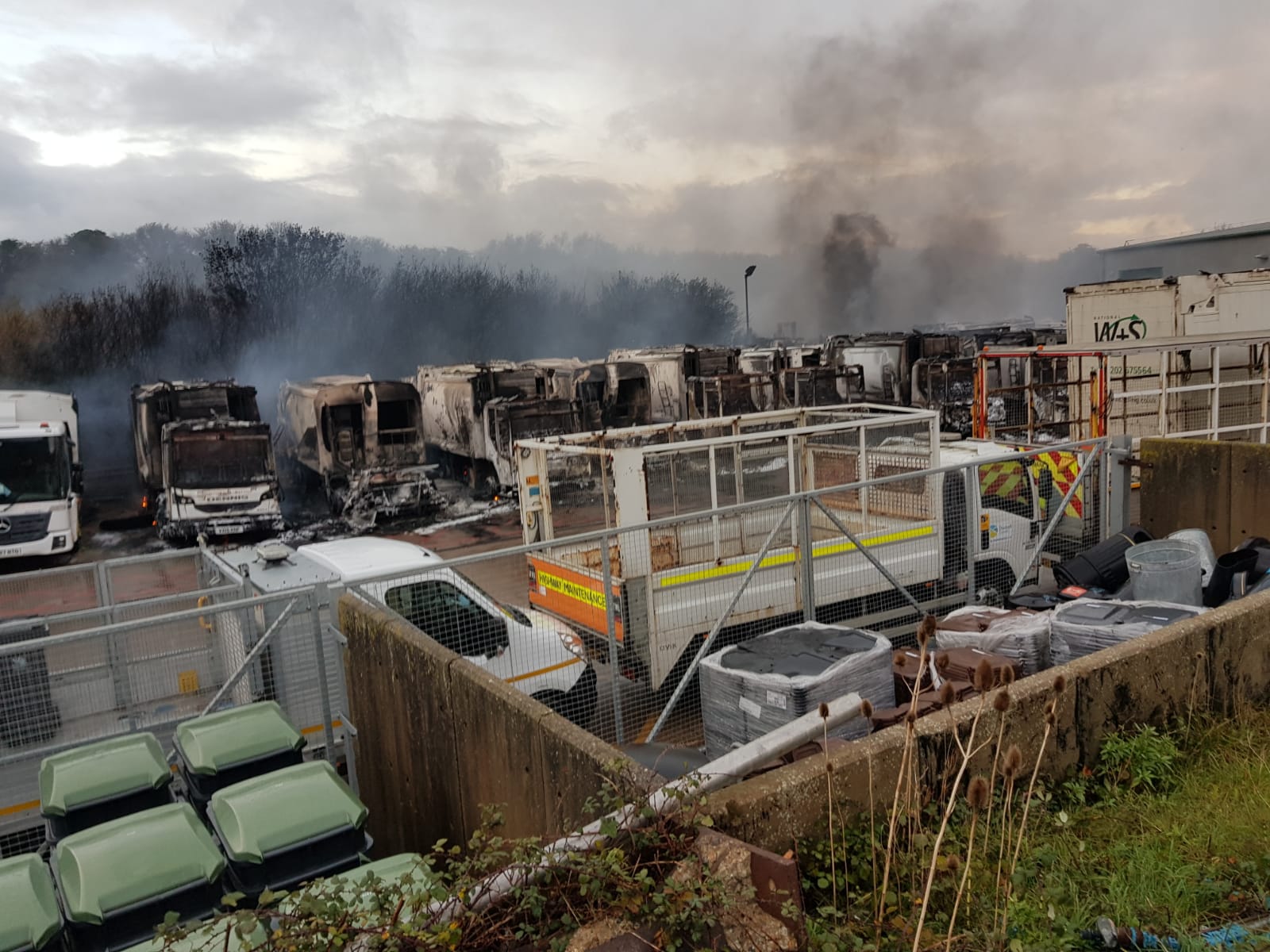
Despite hiring replacement RCVs, the council says the fire has left its waste collection services with reduced resources.
The council has now tendered for 18 pre-used RCVs. The tender document describes the “dependency of hiring replacements in order to maintain vital waste services” as “not economically viable”.
Mr Hodgson added: “The fact the council were able to bring in hire vehicles and rapidly source alternative vehicles strongly suggests they have a robust disaster recovery plan, which is essential when a major incident occurs.
“Of course, this is a council and not an SME; however, the importance of a DRP to any business is clear when disaster strikes. Preventing prolonged downtime and being able to continue to trade and fulfil obligations is critical.”
Recovery
Paul Johnston is client director the Specialist Risk Group, an insurance broker specialising in waste and recycling. He told letsrecycle.com: “The Crookhill depot fire is a prime example of why businesses in the waste and recycling sector should have a robust risk management programme and business continuity plan in place to support their insurance programme.
“Here is where insurance policies and placement should interact and complement a programme of risk management, business continuity and disaster recovery, all working to sustain the business and get the business back to normal trading as soon as possible.
“Thankfully nobody was injured in this fire, but this loss does serve to highlight how losses can escalate. Whilst it is pleasing to hear that the loss will be covered by their insurance, the priority for any business after such a loss is to recover quickly.”
Parking
Danny Lane is an account executive at West Midlands-based insurance broker Richard V Wallis. He told letsrecycle.com limitations imposed by the size of a yard could sometimes lead to accidents.
“Sometimes the worst happens, no matter how much care you’ve taken to prevent a loss”
“It is most definitely not good practice to park vehicles close together as highlighted by incidents such as this, but unfortunately depending on the size of an insured’s fleet and yard, this is not always avoidable,” he said.
“No two sites are the same and an insured needs to work with their broker and insurer to apply the best risk management that they can, to attempt to prevent or at least minimise a loss.”
He added: “Sometimes the worst happens, no matter how much care you’ve taken to prevent a loss and this after all is the main function of an insurance policy: to protect the insured in the event of a loss.”
Short-circuit
Dorset council has received a Fire Investigation Report from Dorset & Wiltshire Fire and Rescue Service, which concludes that the fire started under the bonnet of one of the RCVs.
Heavy rainstorms and high winds in Chickerell that afternoon led to rainwater entering the vehicle’s electrical circuits, the fire service suggests. This caused a short-circuit, igniting the internal components of the vehicle and allowing the fire to take hold.
Dorset & Wiltshire Fire and Rescue Service fire investigation officer Sean Blizzard said: “I can confirm that this was an accidental fire, caused by a weather-related incident. It started in one of the vehicles before spreading to 21 other vehicles on site.
“The great work of our crews prevented the fire spreading to the building, allowing Dorset council to fully reinstate their services within 72 hours.”

Register for free to comment