

Households in the Dwyfor district were the first in the borough to receive a change to their service, after the new timetable was rolled out initially in October 2014 (see letsrecycle.com story).
From next week, households in the Meirionnydd district of the borough will switch from the existing fortnightly collection rota for residual waste, to the three-weekly service.
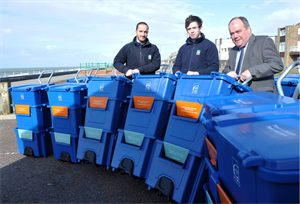
Residents will continue to receive weekly recycling and food waste collections while garden waste will be collected fortnightly once the new timetable has been completed. Dry recycling is collected through a blue box system, with materials sorted at the kerbside by collection operatives.
The Plaid Cymru-led council claims that the change from fortnightly waste collections will help to increase participation in its dry and food waste recycling schemes as it strives to meet Welsh government recycling targets, which will result in financial penalties if missed.
The local authority hopes to make savings of around £350,000 per year in reduced service costs by implementing the new timetable. Plans for the reduced service were approved by the council in April.
Communications
Residents whose collection systems are changing have been informed of the new regime through a series of promotional materials delivered by the council, with a number of ‘cartgylchu’ – a triple-deck trolley designed to make it easier for people to sort their waste for recycling – also delivered to some households.
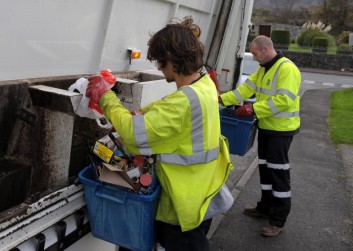
Gwynedd councillor John Wynn Jones, cabinet member for the environment, said: “I would urge people living in Meirionnydd to keep an eye out for the information pack and to read it carefully when it arrives. It explains the changes fully and also includes useful information about the different materials which can go in the blue box and what food is suitable for the brown bin.
“I’m thankful for the way the people of Dwyfor have taken to the new waste collection arrangements, and am confident that people living in Meirionnydd will embrace the changes in the same positive manner.
“Our focus is on encouraging people to recycle and compost as much of their waste as possible so that less and less waste is sent to be buried in landfill sites.”
A predominantly rural region, Gwynedd is the second largest county in Wales by area and has a population of more than 120,000.
The authority follows in the footsteps of Falkirk council by switching to a less frequent service, after the Scottish authority moved to a three-weekly service for 18,000 households in the borough. Bury council in England has also begun the switch to a three-weekly collection system for residual waste.

Very interesting – perhaps Letsrecycle could post the results (increase in recycling rates) so that we can all see how effective this approach really is?