

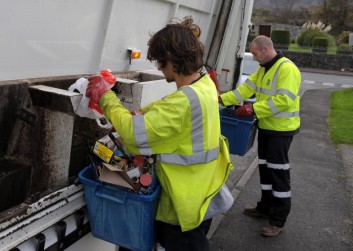
The Plaid Cymru-led council claims that the change from fortnightly waste collections will help to increase participation in its dry and food waste recycling schemes as it strives to meet Welsh government recycling targets, which will result in financial penalties if missed.
The local authority hopes to make savings of around £350,000 per year in reduced service costs by implementing the new timetable. Plans for the reduced service were approved by the council in April.
Households in the Dwyfor district are the first in the borough to receive a change to their service, with the Meirionnydd and Arfon areas to switch during 2015. Householders affected by the move have received an information pack, outlining a timetable for the new service. The council has also produced a YouTube video, providing details of the transition, which can be viewed below.
Residual waste is collected from householders in either a 240-litre wheeled bin, or households are given three black bags per fortnight. Dry recycling is collected through a blue box system, with materials sorted at the kerbside by collection operatives.
Recycling
Residents will continue to receive weekly recycling and food waste collections while garden waste will be collected fortnightly once the new timetable has been completed.
Gwynedd’s recycling rate for 2012/13 stood at 51.2%, falling short of the 52% overall target which was in place across the country. The Welsh Government took the decision not to fine individual councils over their failure to meet the target because the overall target was met. The minimum target is set to climb to 58% by March 2016.
A predominantly rural region, Gwynedd is the second largest county in Wales by area and has a population of more than 120,000.
Falkirk
The authority followed in the footsteps of Falkirk council in Scotland in switching to a less frequent service, after the authority moved to a three-weekly service for 18,000 households in the borough.
Falkirk claims that during the first phase of the scheme, the average amount of waste discarded by households reduced by 2kgs per week and saw an increase in food waste collected by 29% as well as a 6% increase in the amount of ‘dry’ recyclable material collected. It is estimated that if replicated across the borough, the council could save a total of £385,000 per year.
The council last month began the roll out of the new timetable to cover an additional 22,000 homes, with the remaining 25,000 properties to be included from March 2015.
Elsewhere, Bury council in Greater Manchester became the first local authority in England to switch to a three weekly collection system this month, with a new timetable rolled out from October 5.

Register for free to comment