


Compact Power will build the 18 million pyrolysis and gasification facility alongside its existing clinical waste plant at the Bristol city council waste transfer site at Kings Weston Road, Avonmouth..
The new plant will treat 28,000 tonnes of non-recyclable municipal waste as well as 3,000 tonnes of special waste. The plant will produce 1.8 megawatts of renewable power and heat.
” Like all authorities, Bristol faces substantial fines if it fails to meet EU targets. We must look at innovative ways to reduce the waste going to landfill sites. “
– Cllr Matthew Symonds, Bristol CC
Bristol city council's cabinet has given approval for the building of the plant as well as for a contract to supply waste to the plant. Once final legal and financial negotiations are complete, construction can begin and the aim is for the plant to begin processing waste by May 2006.
Councillor Matthew Symonds, Bristol city council's executive member for neighbourhood, said: “Like all authorities, Bristol faces substantial fines if it fails to meet EU targets.
“We must look at innovative ways to reduce the waste going to landfill sites. This project with Compact Power offers a possible solution that could build on our success to date in encouraging recycling,” he said.
Compact Power said the plant will be one of the first of its kind in the world, offering an “environmentally friendly” way to treat waste that is not recyclable.
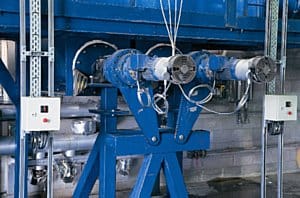 Technology used in Compact Power's clinical waste plant, such as this pyrolyser, will be used in the new municipal waste plant |
Nic Cooper, chairman of Compact Power, said: “I'm sure this project will be closely followed by many councils, who like Bristol are looking for new sustainable means of processing non-recyclable waste. The council has given us the green light, now we need to work with the council officers to make the project happen.”
Technology
The company will be using the technology they pioneered in their Avonmouth clinical waste plant, intending to show the technology can handle large volumes of municipal waste. The Compact Power process heats waste up to high temperatures in the absence of oxygen to convert the material into a fuel gas, which is then used to generate steam and drive turbines to produce energy.
Cllr Symonds said the technology has a “proven track record in dealing with clinical waste” and that “now the time is right to see if it can be applied to household waste too.”

Register for free to comment