


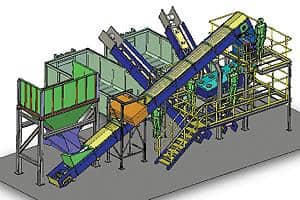
The company is currently installing an industrial “imploder” to break up glass from old televisions and monitors at its site in Lewes, Sussex, as well as one of the first x-ray sorting systems in the country to separate funnel glass from screen glass.
MDJ Light Brothers, which has three sites in Sussex and one in Northamptonshire, already handles around 100,000 tonnes of scrap metal each year.
The so-called “Phase One” facility for CRTs should be up and running for the autumn. Light Brothers is also considering two further phases for the future to expand processing even further, including possible focus to find a use for lower-value material.
Having considered the technology over the past 18 months, the company believes its system can ultimately achieve a materials recovery rate “better than 90%” by weight.
System
The system first involves televisions and monitors being manually dismantled to separate the CRT from other components including surrounding plastics and copper parts, as well as the electron gun.
Implosion is a high-speed system – it uses about 20% less energy than a typical hammermill.
Stefan Michal, Krysteline Group Ltd
CRTs are then fed into the imploder machine – a Krysteline GP15 Implosion system – which sends a sudden burst of energy into the glass to effectively shatter it. As well as CRT glass, the machine can also deal with container or float glass. It can process around 30 tonnes of material an hour.
Speaking to letsrecycle.com, Stefan Michal, managing director for the Wimbourne-based Krystaline Group Ltd, explained that the system was based on the same principle in which wine glasses can shatter when opera singers hit a high note.
He said: “Traditionally this type of glass is broken down by crushing it or grinding it, which is a high-powered, high torque system but relatively slow speed. Implosion is a high-speed system – it uses about 20% less energy than a typical hammermill.”
Mr Michal said the resulting grains include no sharps, and can vary in size from 400 microns to up to 15cm, although the Light Brothers system uses the upper range for the glass pieces to be suitable for x-ray sorting.
Jonathan Light, managing director of Light Brothers, concurred, saying that the Krystaline system was “the only processor that could deliver the right specification of un-abraded feedstock to anable effective x-ray specification”.
X-rays

The Varicon-X machine identifies the different types of glass based on different x-ray absorption rates, before instructing the separation system to direct the various glass grains into the appropriate hoppers. It is the first time one of the machines has been used for separating CRT glass in the UK.
Initially, it will be sorting around 15,000 tonnes of CRT glass each year, but will be able to process more than twice that tonnage using normal shift patterns.
Even with the rising popularity of LCD and plasma flat screens, Light Brothers believes there will be a need for dealing with CRT glass for “at least the next decade”.
“We looked at several systems for accurately separating the core types of CRT glass,” said Mr Light. “Our visit to the S+S factory in Germany, where the machine tested our own samples, was very impressive. Being able to supply customers such as screen manufacturers with guaranteed quality, reclaimed glass will make a big difference to the economics of CRT glass recycling.”

Register for free to comment