


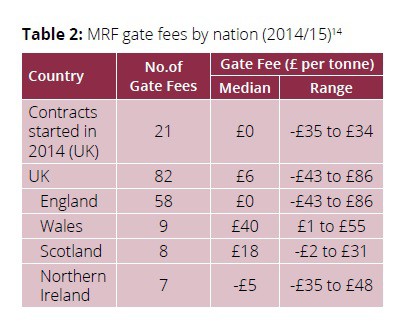
According to WRAP’s eighth annual gate fees report published today (July 7), the median gate fee paid by local authorities for MRF services was £6 in 2014/15, with feedback from waste management firms suggesting a continuing trend increase in MRF gate fees in recent years.
Gate fees are paid either by a local authority to a MRF operator for processing dry recyclables, or a fee paid to a local authority by a MRF operator for the material.
And, looking ahead, 65% (99 local authorities) said they expected MRF gate fees to rise, citing increasing emphasis on the quality of input material, higher MRF operating costs and the declining value of materials.
However, this year’s £6 figure appears to show a fall from the £10 MRF gate fees reported in 2013/14 (see letsrecycle.com story).
WRAP explains that the two figures are not directly comparable, though, due to differences in how the sample was selected, although it adds that these figures “can be used as a guide to show the direction of change”.
The 2013/14 median MRF gate fee is reportedly based on all material streams, whereas this year’s equivalent is based on gate fees for MRF contracts that sort four or more materials.
The survey also found that as many as 33 local authorities – 40% of those surveyed – reported paying either no gate fee at all at MRFs, or receiving payment from the MRF for their material. When haulage costs and revenue were included in the figure, this rose to 46%.
Where year of contract commencement was submitted, 46% of MRF contracts surveyed this year were signed in 2013 and 2014.

However, the highest revenue for local authorities is typically achieved on older contracts, when market prices for materials were higher, the report states.
Based on information from local authorities and waste treatment companies, today’s report presents the median and range of gate fees in 2014/15 for a variety of recycling and waste treatment options, and generally finds relatively little change from previous years.
The largest increase in median gate fees found by WRAP this year is for material sent to energy from waste (EfW) facilities constructed before 2000. Here, fees have risen to £73 per tonne, up from £58 previously, although WRAP believes this is due to it receiving more responses for pre-2000 facilities in this year’s survey than in the last.
Meanwhile, the median EfW gate fee for facilities constructed after 2000 is £99 per tonne, up £5 per tonne on last year.
Waste wood
A marginal rise of £3 is reported in the median gate fee paid for recycling and recovery of all grade of waste wood collected at household waste recycling centres (HWRCs), which now stands at £35 per tonne.
Waste sent for mechanical biological treatment (MBT) has also received a small rise in the median gate fee, up from £84 per tonne in the last survey to £88 per tonne this year.
Organics
Gate fees for organics and composting have generally remained remain in line with the WRAP findings in previous years, with the median gate fees for open windrow composting for green waste and in-vessel composting (IVC) for food and green waste both unchanged from the previous two surveys at £24 per tonne and £46 per tonne respectively.
The median charge paid by local authorities for food waste treated at anaerobic digestion (AD) facilities has also stayed the same at £40 per tonne, although 50% of local authority contract AD gate fees were for contracts signed in 2013 and 2014.
 WRAP also said feedback received from AD operators indicates that gate fees for food waste from commercial and industrial sources are below those charged for household food waste.
The report was written on behalf of WRAP by consultancy Eunomia, based on a survey of facilities carried out between December 2014 and March 2015.
And, since the survey was carried out, letsrecycle.com in May reported a drop in AD spot market gate fees as more capacity for treating food waste comes online (see letsrecycle.com story).
Marcus Gover, director at WRAP, commented: “Finding a clear picture of treatment costs in the UK is a difficult task. Our gate fees report highlights how variable charges are for waste management options, and how difficult this market can be to navigate without help. In a time when budgets are stretched, and with the backdrop of a more volatile market for secondary materials, our gate fees report remains a key resource authorities can use to help inform local decisions.”


Register for free to comment