

The UKs WEEE collection rate rose fractionally in 2012, aided by a fall in the tonnage of new products placed onto the market, data published by the Environment Agency last week has shown.
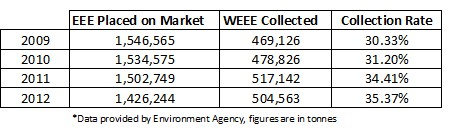
The provisional figures, sent to compliance schemes on Friday, show that the total collection rate for household and non-household waste electrical and electronic equipment (WEEE) reached 35.37% for 2012 compared to a total collection rate of 34.41% achieved in 2011 (see letsrecycle.com story).
This is despite the actual tonnage of material collected falling, from 517,142 tonnes in 2011, to 504,563 tonnes last year. However, the collection rate has remained higher as the tonnage of new products placed onto the market has also fallen, from 1,502,748 in 2011 to 1,426,243 tonnes in 2012.
The collection rates are calculated proportionately by linking to the amount of new electronic and electrical equipment (EEE) placed on the market.
Despite falling short of the 45% target set out in the Recast of the WEEE Directive which will apply to Member States from 2016, it could be possible for the UK to meet the target on its existing collection level, if non-obligated WEEE received from outside of the producer compliance system is counted towards recycling targets.
The data shows that a total of 158,039 tonnes of non-obligated WEEE was collected in 2012, more than double that received in 2011. And, if both obligated and non-obligated WEEE are counted, the overall collection rate would rise to around 46%.
BIS
Under the Recast, Member States are able to give substantiated estimates of WEEE collected for recycling, which the UK will be able to do after the revised Directive takes effect from 2014.
A spokesman for the Department for Business Innovation and Skills (BIS), the government department responsible for the UKs WEEE sector described the results as encouraging. BIS is due to consult on changes to the WEEE system to bring it in line with the Recast in the coming weeks.
The spokesman said: “The provisional data for 2012 shows over 500,000 tonnes WEEE was collected in the UK last year on behalf of producers. This represents 35 per cent expressed as a percentage of EEE placed on the market – up marginally on 2011.
“However, that figure rises to 46.5 per cent when taking into account reported data for WEEE that was not treated by producer compliance schemes. The UK must achieve a rate of 45 per cent by 2016 to meet new EU targets in the revised WEEE Directive. This is encouraging data.”
REPIC
And, Phil Morton, chief executive of producer compliance scheme REPIC commented that the fall in tonnage of material collected should not be a concern to the WEEE sector.
He said: It is to be expected that the tonnage of WEEE collected is falling, despite the increased collection rate. This is a direct result of the continuous ‘light weighting’ of many products.
TVs are one example of this; just compare a new 42 inch flat panel TV today to its CRT counterpart of years ago – it is a fraction of the weight. This means that while the absolute tonnages of WEEE has fallen, and may continue to fall, the rate of return relative to the sales of new EEE has gone up and may well continue to increase, so we are actually capturing proportionately more.
This phenomenon has been recognised in the recast of the WEEE Directive, which moves away from the simplistic one size fits all target of 4kg per person, to a more realistic WEEE target based on a percentage of the average weight of EEE placed on the market in the preceding three years.
B2B
Meanwhile, the figures show that the recorded collection of WEEE generated by businesses (B2B) remained at a similar low level as during previous years, with a recorded collection rate of 4.98% throughout 2012, compared to a total of 35% for WEEE from households.
But, compliance schemes for the non-household WEEE sector have argued that there is also a large amount of B2B WEEE being recycled or reused that does not enter the WEEE system.
WEEE Conference
Proposed changes to the UK’s WEEE system are set to be discussed at a one-day conference in London on May 1 2013 hosted by letsrecycle.com, entitled Reshaping the WEEE Regulations. To find out more, click here.
Responding to the latest figures, David Burton, project director of business sector compliance scheme B2B Compliance, said that data collection methods should be altered to ensure that the actual level B2B WEEE recycling is recorded.
He said: The so-called low collection rates of B2B WEEE remains unchanged at around 5% clearly demonstrates the inadequacy of the current system of counting what happens to end-of-life equipment from the non-household sector. Much B2B EEE is either collected for refurbishment, or deployed under extensive long term maintenance contracts.
In the latter case such EEE is subject to constant updating and, ultimately, stripped for spares in all circumstances the spare parts are out of scope and the discarded shells, not being complete products, are not WEEE by definition. In all reality the collection rate of B2B WEEE and Used EEE is probably on a par with the B2C sector but the majority is simply not being captured by the current data collection methodology.

Register for free to comment