

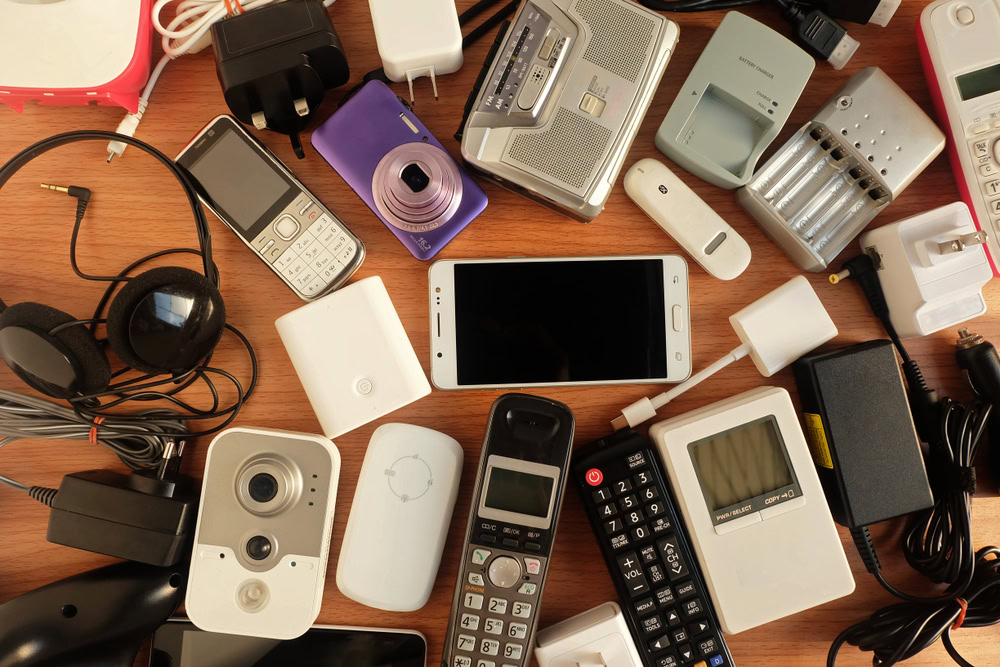
The UK’s e-waste challenge is not just about what is thrown away, but what isn’t. Material Focus estimated that UK households are holding onto 880 million unused electrical items.
Much of this stockpile reflects a breakdown in trust and accessibility. Consumers are often unsure whether devices will be reused or simply scrapped, while concerns around data security remain a significant barrier for anything “smart”.
Even when the intention to dispose responsibly is there, inconvenience and limited financial incentive can stall action.
The result is a system where value – both material and functional – sits idle in drawers and cupboards, disconnected from the pathways that could put it back into use.
For Sonia Lange Ramontja the starting point was a kettle.
She explained: “I was having trouble getting rid of my kettle. It still worked, but I wanted to replace it and genuinely didn’t know what to do with it. I didn’t want to just throw it in the recycling centre, but I had no idea where it could go.”
The barriers were not just practical, but psychological: uncertainty over where devices end up, and whether data is properly erased.
“When I started researching, I realised just how difficult it was to do any of this easily: to rehome your electronics responsibly, get your data properly deleted, and have any visibility over where your devices were going,” Lange Ramontja continued.
“That gap is what Retapp is built to close.”
Retapp: App for consumers and recyclers
Retapp’s proposition is to simplify that journey through a consumer-facing app, while building infrastructure behind the scenes for recyclers and refurbishers.
Users scan a device using their phone, allowing the platform to assess make, model, age and condition. The information is then benchmarked against live market data and refurbishment costs to generation a valuation.
Lange Ramontja explained: “If the device has resale value, the user gets money back. If it doesn’t, they receive rewards instead.
“This gives people a clear picture of what their device is actually worth before they do anything with it.”
From there, devices are routed to appropriate downstream partners, rather than defaulting to a single outlet or waste stream.
Intermediary between consumers and recyclers
Retapp positions itself as an intermediary layer – one that does not collect or refurbish devices directly, but connects them to the most appropriate endpoint.
For operators, the model also introduces a procurement function. Devices can be assessed before arrival, allowing businesses to understand incoming stock and reduce manual triage.
For recyclers and refurbishers, one of the persistent challenges is the variability of quality, condition and data.
Retapp’s system aims to address this by front-loading information.
Lange Ramontja said: “We’ve built a very user-friendly flow that refurbishers can ask their customers to complete before a collection or assessment takes place.
“That means they’re already working with pre-graded, pre-qualified device information before anything reaches them.”
The platform also incorporates compliance and reporting tools, reflecting increasing demand for traceability and alignment with circular economy targets.
Making compliance ‘the easy option’
When asked about early challenges, Lange Ramontja said: “Logistics. We’re creating a new system for electronics to flow to the right place, and the unit economics must work at every step of that chain.”
Following its pilot phase, Retapp made the decision not to handle devices directly – clarifying its role as a coordination layer rather than an operator.
Looking ahead, Retapp’s ambition extends beyond individual transactions.
She added: “We want Retapp to be the infrastructure layer that the e-waste ecosystem runs on.
“In five years, we’d expect device take-back at any major retailer, council, or corporate to be powered by standardised AI grading and device-level tracking as a baseline, not a differentiator.
“The regulatory environment is moving firmly in that direction, and we want to be the platform that makes compliance the easy option rather than a burden.”

Register for free to comment