



The fall comes as the UK’s Office for National Statistics reports a 20.4% reduction in economic activity in April.
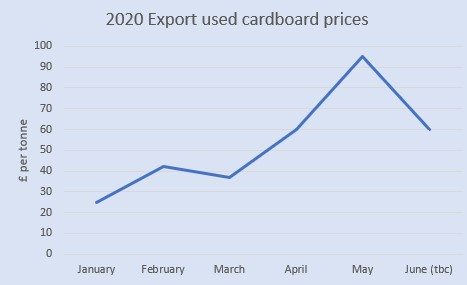
Market prices for used cardboard (Old KLS or OCC) shot up to as high as £120+ per tonne following lower arisings of the material and paper mills concerned to ensure they had sufficient stocks as they were continuing to operate during the pandemic. Prices for mid-grades, typically from offices and printers, have not seen significant falls because of reasonable demand although some tissues machines are said to be taking downtime.
Question
The waste (or recovered) paper market for used cardboard has dropped in what is being described as a “market correction which has happened as quickly as prices rose”. The question is now as to what happens next if the economic downturn continues and turns into a full blown recession.

OCC prices are now roughly back to where they were earlier in the year at around half of the peak prices.
In the 2008 recession the price for export used cardboard, for example, fell from a high of around £60 per tonne in October to the lowest price of around £10 in November and stayed low until February the following year. This year’s fall is sharp but, so far at least, only to price levels available before the drop; one reason for this could be that there are lower arisings whereas in 2008 there were reasonable volumes of supplies.
Continental demand
The reduction is put down largely to the fact that on the European mainland, local waste paper supplies have picked up again and mills are also less anxious about needing to secure material because they have sufficient finished product to meet the lower “recession” demand. And, the order book is at best only steady from south east Asia with countries there generally unwilling to pay higher prices because they too have reduced demand for finished product and they also need to ensure production is cost-effective. India is facing port disruptions and mills closed because of the pandemic.
Now, attention within the waste – or recovered – paper sector is focusing on two areas. One is the likely impacts of an ongoing recession and what it may mean in terms of demand for finished product made by paper mills.
A second area of discussion is the impact of the final closure by China of its doors to the importing of waste paper later this year.
PRNs
One bright note is the support being given to the OCC market, and to a lesser extent mixed paper, by the PRN and export PERN, which are currently worth about £20 a tonne. One exporter remarked that an export price could be as low as £35 a tonne now and adding in the £20 PERN, a sum of £55 can be paid.
“Everyone is waiting to see what happens when things open up.”
Simon Ellin
Chief executive, Recycling Association

Commenting on the current market, Recycling Association chief executive, Simon Ellin, told letsrecycle.com: “One of the problems is that European mills are well stocked and so some are taking downtime. There is a split on what the mills are making, it if is for food and some other retail the orders are there for finished product but commercial demand is very quiet.
“This situation is also not helped by weak demand from Asia. We are seeing very little demand from Indonesia and virtually nothing from India. In shipping terms West to East trade is just not happening.”
Mr Ellin also commented on the importance of the PRN at around £21 per tonne. “The PRN is doing what it was designed for.”
On the economic front though, he said: “We are all very worried. Everyone is waiting to see what happens when things open up and there may be a mini-boom. Perhaps people say ‘I can afford to replace my wardrobe’, as they decide to spend again. I think we will have a realistic indicator of the economy after the government has told us that lockdown is ending.”
Heavy industry
Colin Clarke, managing director of export company Winfibre, which supplies China and south east Asia, said: “We are seeing a massive correction from the rise caused by the local shortfall in generation during the pandemic. The big difference was that in Europe and the UK mills kept running whereas in China and south east Asia many paper mills – as was heavy industry – were closed. Asian markets are coming back in a more staggered approach from the post-COVID situation.”

Mr Clarke also highlighted the need for merchants to keep the ability to charge. “This market can be quite dangerous for the industry. Charges should have been kept during the price rises.”
Mill view
One UK mill source confirmed the knock-on effect of order shortages: “Prices are not crashing but they have moved down a lot. It is down to a lack of sales of finished product and most mills have good stocks. You will see mills across Europe taking downtime, a lot of maintenance will be happening over the next month.”
And, he added that the lower prices could encourage more interest from south east Asia and countries such as Indonesia but again this was linked to the Chinese economy which is weaker than it was a year ago.
‘A little scary’
Pankaj Chowdhary, managing director of Ekman Recycling Ltd and an expert on trade to Asia, also noted the lack of demand for new product. He described the current situation as “a little scary in terms of demand for the end production material”.

Mr Chowdhary said: “We have seen market prices going up due to a collection shortage but it didn’t mean the industry was doing well. Asian mills need to make a margin on their linerboard production but it was not possible at the higher prices but at lower raw material prices this could help move product.”
COVID-19 is now impacting on India, he said. “The situation is so poor that mills are running at about 40% there because of a lack of demand and there is a bit of a double whammy with as much as 6-8 weeks congestion at ports. This also kills some appetite for fresh material orders.”
‘Heading south’

From a merchant’s point of view, Reuben Bolton of Ipswich-based Bolton Bros, who is a past president of the Recycling Association, said: “Prices are heading south. The price rises were definitely a temporary blip in early May which has corrected itself just as quick. Recovery was non-existent but now there is more cardboard in the market but mill order books are low.”
Mr Bolton also commented that the sector was under pressure because lower volumes of material meant reduced income and so margins had to be maintained. “Service charges have to be reviewed, you don’t have a choice and it is a hard pill to swallow.”

Register for free to comment