

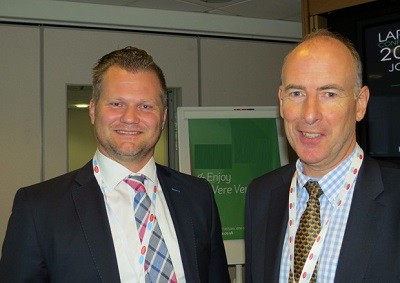
A session chaired by Dave Thomas, recycling officer at Rushcliffe borough council, with presentations from Herman van der Meij of Viridor and Peter Clayson of DS Smith, saw delegates admit to confusion over whether or not residents should be told to leave lids on bottles and whether it was worth collecting pots, tubs and trays (PTT). It was also queried whether it might be better just to burn PTT for energy.
On bottle lids the discussion heard advice that it could be down to local circumstances but that technology is quite able to separate the lid material when bottles are sorted.
And, in terms of PTT, Mr van der Meij, who is managing director of Viridor Resource Management, was adamant that the material should be recycled.
He was responding to a question from one delegate who asked: “With pots, tubs and trays, shouldn’t we be honest and say they can’t be recycled and then send them for energy? Rather than saying residents want to recycle, and then we do what residents want to do, we should realise that they only do it because they think it is the right thing.”
Mr van der Meij said: “You are asking the wrong person, I think we should recycle. Yes we have a big energy recovery programme and we have to challenge ourselves to get more fuel for burning but we also keep recycling and PTT can be recycled.”
Contamination
But, he emphasised that contamination from food waste or from other materials can hamper recycling. “Where it goes wrong is that PTT can be contaminated, if it is PS, PP or PET it has a very positive value. It goes wrong when for example, a flower pot of PS or PP has a metal ring round it because this makes it look more shiny. If it is just PTT, and you look at the different polymers, they have a high value.”
Mr van der Meij had earlier, in a presentation, expanded upon the difficulties that contamination even at the producer end can cause. He cited the case of some bottles for Heinz ketchup and described how one bottle flake dropped in value from £750-800 per tonne to lower than £300-400 per tonne after one customer said they had found silicon in the flake. “Then we had to trace everything back and then we found out that a producer who works for Heinz ketchup decided to put a membrane in the bottle so when it was squeezed it didn’t leave sticky residue. If the flaking process costs £400 a tonne then you can’t do this.”
In his presentation the Viridor director also emphasised the need for partnerships between contractors and councils. In times of austerity and lower commodity values, he reasoned: “The answer is partnership, working alongside each other to understand things.”
Paper
The Larac (Local Authority Recycling Advisory Committee) workshop also saw a presentation from Peter Clayson, business development manager at DS Smith Recycling. He noted that the company as well as having paper mills had 177 corrugated plants that make cardboard boxes in Europe and handled 5.5 million tonnes of recycled fibre across the company in its recycling division.
“In terms of our paper recycling model, it is a very circular model and we are trying to design out weight and reducing the amount of packaging.”
Mr Clayson, who is also chair of the Resource Association, emphasised the need for quality in recycling and said it was an “indictment of our system that the Green Fence in China came before we looked at a quality focus in the UK.”
The paper industry today he said is “marked by the type of materials those mills are producing and seeking, it reflects the changes in consumption. Shotton and Aylesford associated with people buying less newsprint. Whereas if you think about the investment at the DS Smith mill in Kemsley, or SAICA or Smurfit, they are thinking about producing packaging. Packaging is the growth market because of our lifestyle change because of things like internet shopping and more demand in the retail market.”
Feedstock
Mr Clayson continued: “This is changing the nature of our feedstock from a local authority point of view so from the household stream the mix is getting harder, more brown compared to newsprint. We are finding that we are having to adapt our processes to deal with a more mixed makeup. This is important for us because at the other end of the cycle, our customers are demanding more in terms of what they want to do in terms of it protecting their product and selling their product.”
There are three areas for discussion, he told delegates. These were with regard to relevant policy and “whether in the current political environment we are going to get legislation has to be debated, but it could be a voluntary agreement for suppliers working with reprocessors. A second is better enforcement of existing legislation such as duty of care and, third, much, much better communication to ensure people understand the cycle and the material cycle.”

Register for free to comment