


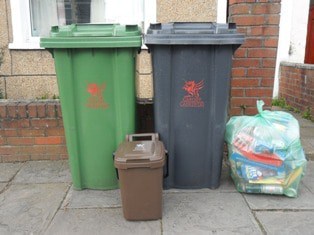
Waste management firm Veolia has launched a national PR offensive against more unnecessary bins at the kerbside ahead of EU requirements for separate recycling collections which come into force from next year.
According to the firm, which has published findings of a YouGov poll in support of its campaign, some reprocessors are putting in place measures in response to the forthcoming EU rules which could cause a rise of up to 19 bins on UK doorsteps.
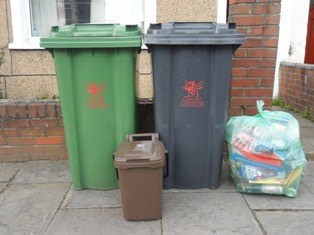
A spokesman for Veolia said it had reached the figure of 19 bins on the basis that the forthcoming EU regulations could feasibly be interpreted as meaning all materials should be separately collected at the kerbside.
Under the revised EU Waste Framework Directive, from January 2015 separate collections of at least paper, metal, plastic and glass are required where they are technically, environmentally and economically practicable (TEEP) and appropriate to meet the necessary quality standards for the relevant recycling sectors.
The waste management firm’s comments are likely to be in response to claims that commingling and MRF sorting of materials cannot yield the necessary quality of material for use by reprocessors, a belief that is firmly challenged by operators of sorting facilities.
‘Pragmatic’
Veolia is calling for a more pragmatic approach to the regulations, suggesting that householders should be asked to separate material into no more than four containers glass, organic waste, other recyclable waste and black bag waste in order to keep it simple for consumers.
And, in a press release sent out to national media yesterday (August 13), the firm said it had commissioned a YouGov survey of 2,500 adults which found that 69% of the UK public did not want to separate their waste and recycling into more than four containers, while only 12% of those polled said six or more bins were reasonable.

‘Veolia is as committed to recycling as the EU, its our business, but we want to ensure the new EU laws are viable for the public and practical for residents. Some reprocessors are trying to put measures in place that could cause a rise of up to 19 bins on UK doorsteps!’
Richard Kirkman, Veolias technical director
In addition, the YouGov survey found that 60% already separate out glass and a further 35% are willing to do so, while 55% of those polled currently separate out organic waste and a further 36% would be happy to do so.
Richard Kirkman, Veolias technical director, said: Veolia is as committed to recycling as the EU, its our business, but we want to ensure the new EU laws are viable for the public and practical for residents. Some reprocessors are trying to put measures in place that could cause a rise of up to 19 bins on UK doorsteps!
Commingled
Mr Kirkman suggested that commingled collections of recyclables are workable in the UK and could produce high quality materials.
He said: With modern technology, paper, metal and plastic can all be separated post-collection to the required standard. The public are very supportive of recycling, but we must make it easy for them.
The YouGov survey also found that 94% felt recycling was important and 92% already separate out their recyclable waste. And, the poll showed, 38% said the current EU target to recycle 50% of household waste was too low, while only 8% felt it was too high.
It is not the first time Veolia has waded into the debate over recycling collections. In an interview with the Daily Mail earlier this year (see letsrecycle.com story), Veolias UK and Northern Europe director Estelle Brachlianoff said: We need something that is effective, but simple to understand. One bin for recyclables, one for glass and one for the rest. That would make a lot of sense.
Councils
Related Links
A number of local authorities have moved to try and justify their collection systems in regards to TEEP ahead of the EU requirements coming into force next year, including Hull city council (see letsrecycle.com story) and Castle Point council in Essex (see letsrecycle.com story).
Defra scrapped its plans to produce guidance on TEEP and separate recycling collections earlier this year, although a draft of the guidance it was working on was released in May (see letsrecycle.com story).
In place of the Defra guidance, a working group led by WRAP and the London Waste and Recycling Board (LWARB) have stepped in to publish a route map in April (see letsrecycle.com story).


Register for free to comment