

That is the message from the World Banks urban development team which has published a report entitled What a Waste: A Global Review of Solid Waste Management. The report offers for the first time consolidated data on municipal solid waste (MSW) generation, collection, composition, and disposal across the world.
The report estimates that the amount of MSW will rise from the current 1.3 billion tonnes per year to 2.2 billion tonnes per year by 2025. Much of the increase will occur in rapidly growing cities in developing countries.
The annual global cost of this necessary solid waste management is projected to rise from the current $205 billion (132 billion) to $375 billion (241 billion), with the cost increasing most severely for those cities in low income countries.
Reliable global MSW information is either not available or incomplete, inconsistent, and incomparable, the reports authors note. Nevertheless, they point to a looming crisis in MSW treatment as living standards rise and urban populations grow.
Improving solid waste management, especially in the rapidly growing cities of low income countries, is becoming a more and more urgent issue, said Rachel Kyte, vice president of sustainable development at the World Bank.
The findings of this report are sobering, but they also offer hope that once the extent of this issue is recognized, local and national leaders, as well as the international community, will mobilize to put in place programs to reduce, reuse, recycle, or recover as much waste as possible before burning it, and recovering the energy, or otherwise disposing of it. Measuring the extent of the problem is a critical first step to resolving it.”
Service
The report notes that municipal solid waste management is the most important service a city provides. In low-income countries, MSW is often the largest single budget item for cities, and one of the largest employers. A city that cannot effectively manage its waste is rarely able to manage more complex services such as health, education, or transportation.
The report shows that the amount of municipal solid waste is growing fastest in China (which surpassed the United States as the worlds largest waste generator in 2004), and other parts of East Asia, and part of Eastern Europe and the Middle East. Growth rates for MSW in these areas are similar to their rates for urbanization and increases in GDP.
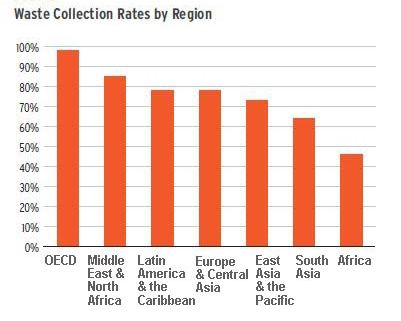
There is a direct correlation between the per capita level of income in cities and the amount of waste per capita that is generated. In general, as a country urbanises and populations become wealthier, the consumption of inorganic materials (e.g. plastics, paper, glass, aluminium) increases, while the relative organic fraction decreases.
What were finding in these figures is not that surprising, said Dan Hoornweg, lead urban specialist in the finance, economics, and urban development department of the World Bank and co-author of the report.
What is surprising, however, is that when you add the figures up, were looking at a relatively silent problem that is growing daily. The challenges surrounding municipal solid waste are going to be enormous, on a scale of, if not greater than, the challenges we are currently experiencing with climate change. This report should be seen as a giant wake-up call to policy makers everywhere.
Possible solutions
The authors of the report say an integrated solid waste management plan is needed in cities to approach solid waste in a comprehensive manner. Key to such a plan is consultation and input from all stakeholders, including citizen groups and those working on behalf of the poor and the disadvantaged. Public health and environmental protection aspects of any such plan are also critical.
Related Links
The report also spells out policy recommendations for reducing greenhouse gas emissions (GHG), many of which emanate from inefficient solid waste management practices.
Post-consumer waste is estimated to account for almost 5% of total global GHG, while methane from landfills represents 12% of total global methane emissions. The report says that a number of practical approaches could be applied in most cities, including:
- Public education to inform people about their options to reduce waste generation and increase recycling and composting;
- Pricing mechanisms (such as product charges) to stimulate consumer behaviour to reduce waste generation and increase recycling;
- User charges tied to the quantity of waste disposed of, with (for example) consumers separating recyclables paying a lower fee for waste disposal; and/or
- Preferential procurement policies and pricing to stimulate demand for products made with recycled post-consumer waste.

Subscribe for free