

Rare earth magnets are classed as critical minerals and are integral to a wide range of modern technologies, including wind turbines, electric vehicles, medical equipment, pumps, robotics and consumer electronics.
With demand expected to rise sharply as electrification and renewable energy deployment accelerates, the new facility aims to help secure a more resilient and sustainable domestic supply of these materials.
Hydrogen-based recycling technology
The new facility, located at Tyseley Energy Park in Birmingham, uses a hydrogen-based recycling process developed by researchers at the University of Birmingham.
Known as Hydrogen Processing of Magnet Scrap (HPMS), the technology enables rare earth magnets to be extracted from end-of-life products without the need for full disassembly.
By using hydrogen to break down magnet-containing components, the process converts waste materials into a reusable source of rare earth alloys.
These can then be used to manufacture new metals, alloys and sintered magnets, while reducing environmental impacts, costs and supply chain risks associated with primary extraction and overseas sourcing.
Professor Rachel O’Reilly, Pro-Vice Chancellor of Research at the University of Birmingham, said: “By developing complete circular solutions for the supply of critical minerals such as those found in rare earth magnets, the University of Birmingham is playing an essential role in helping the UK become a technological leader in this field.”
Commercial site
The Tyseley site represents a scale-up from earlier proof-of-concept work.
Previous facilities were able to process batches of around 50 to 100 kilograms, whereas the new plant will aim to recover more than 400 kilograms of rare earth alloy per batch.
On a single-shift basis, the facility has the capacity to produce up to 100 tonnes of new sintered magnets per year, rising to over 300 tonnes annually when operating multiple shifts.
The £4.5 million recycling facility has been funded by Innovate UK’s Driving the Electric Industrialisation Centres (DER-IC) programme, with additional support from the Innovate Climates Programme, EPSRC, the Advanced Propulsion Centre and EU Horizon grants.
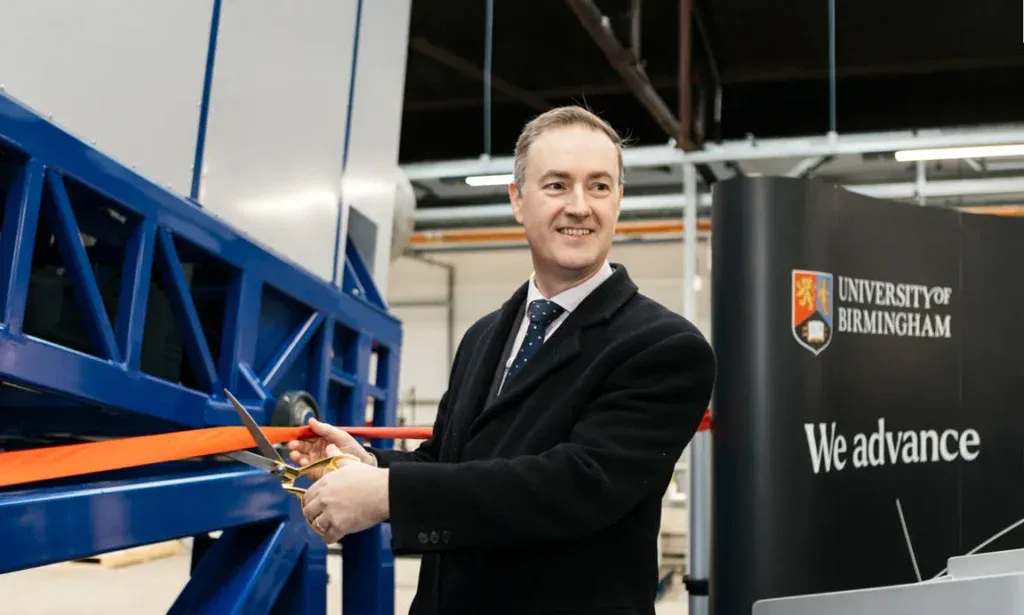
The site was officially opened by Chris McDonald MP, Minister for Industry at the Department for Energy Security and Net Zero and the Department for Business and Trade.
Critical Minerals Strategy
The launch comes against the backdrop of growing national focus on critical minerals.
In November 2025, the UK Government published its updated Vision 2035: Critical Minerals Strategy, setting out plans to improve resilience, reduce dependency on overseas supply chains and support domestic processing and manufacturing capability.
McDonald commented: “This new facility is great news for the West Midlands which will help create hundreds of well-paid local jobs and is testament to our world-leading expertise in rare earth recycling.
“This is our Critical Minerals Strategy in action, bringing sintered magnet manufacturing back to the UK for the first time in 25 years and backing innovative projects to boost our critical minerals supply chains and power the green industries of the future.”
Find out more about electronic waste and critical minerals sector updates, innovation and practical strategies for recovery, reuse, recycling and compliance at the National E-Waste & Critical Minerals Conference 2026 on 11 March 2026.

Register for free to comment