

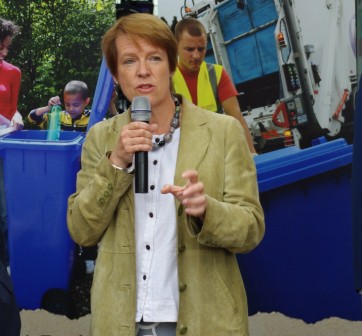
The launch of the borough-wide roll-out of the RecycleBank incentive scheme prompted one of the most heavyweight political endorsements seen for recycling for many years with two secretaries of state present.
And, for Mrs Spelman, it was an opportunity to indicate a little of the thinking behind the coalition government's stance on local authorities and recycling, while at the same time point to a broader review of waste policies and what the coalition will plan
going forward.
Recycling
The concept of 'Big Society' and localism were both features that emerged yesterday in Windsor. While the day was lead by the Department for Communities and Local Government, with secretary of state Eric Pickles lambasting the idea of bin taxes which he accused the previous government of introducing (see letsrecycle.com story), it was left to Caroline Spelman to champion the reasons for recycling. She took this up with some strong words about the need to avoid landfill and later, in an interview with letsrecycle.com, to say how local authorities need to discuss the types of recycling services with their residents.
In terms of landfill diversion, Mrs Spelman did not elaborate on the potential for landfill bans on materials, suggesting that a review of waste policy is on the cards. Earlier, in an address to the RecycleBank audience, she had noted: “In this day and age things like wood, and glass and plastic and metal should not be going to landfill anyway, those are valuable commodities that can be recycled.”
Behaviour change
In a statement of views about the RecycleBank scheme, Mrs Spelman said: “Windsor and Maidenhead has got it right by rewarding people for voluntarily doing the right thing, not penalising them for doing the wrong thing. That is how we can change behaviour, improve the environment and get people to play their part in a Big Society.”
Speaking to letsrecycle.com, Mrs Spelman – who is MP for Meriden, a constituency with rural and urban areas in the heart of England – highlighted the importance of local authorities listening to local residents rather than central government saying how recycling should be done. In particular she said that decisions on commingled recycling in wheeled bins, such as in Windsor and Maidenhead, were down to local authorities themselves.
She said: “I think that the early pilots here in Windsor and Maidenhead show that the public have views about the receptacles that they find easier to use for recycling but I think what a local council should do is to listen to the members of the public. The receptacles for recycling depend entirely on local conditions.”
Referring to the blue bin scheme in the Royal borough, she continued: “For example, in my constituency where there are 46 tower blocks, it would be difficult to accommodate a commingled bin like that; if you have a more suburban location a wheelie bin might work quite well. So, I think it's wrong to be prescriptive from the centre about the type of receptacle, that is what the council has to do in conjunction with its residents. What we have to do is to listen to people and make it convenient for people – I think they are more likely to recycle if it is done in a way that works for them.”
Food waste
Turning to the issue of food waste as a potential follow-on from successful recycling for local authorities, the secretary of state that this would depend on local conditions. She explained: “in a local authority like Windsor and Maidenhead quite a lot people will have the capacity to compost food waste, but if you go to a very urban constituency, like parts of mine, they have no opportunity to compost their food waste so I think once again the local authority needs to work with local residents on the best approach. Food waste should not be going to landfill.”
Mrs Spelman went on to highlight the importance of anaerobic digestion as a treatment solution and the need for steady input streams. The secretary of state said: “There are places like hospitals and big catering outlets which have quite a large volume of food waste which could easily be collected and used for anaerobic digestion, providing a constant stream which could be used by a digester, which needs a steady stream. The bottom line is that organic waste should not be going to landfill.”

Register for free to comment