

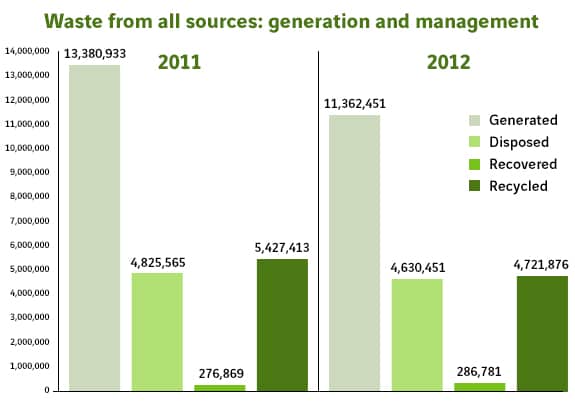
The waste statistics recorded by SEPA’s Waste Discover Data tool show the amount of waste generated, recycled, recovered and disposed across all areas in Scotland for the period of 2011 to 2012.

In total, the amount of waste arisings generated in 2012 amounted to 11,362,451 tonnes – a decline from the 13,380,933 tonnes recorded the year before.
It brings together information on the waste collected from all sources, including commercial and industrial, demolition and construction waste, and household municipal waste.
As well as a drop in the amount of waste arisings generated in 2012, the year also recorded a record low in the amount of waste disposed with 4,493,924 tonnes sent to landfill. This means the amount of waste sent to landfill in Scotland has decreased by 39% since 2007.
BMW
Meanwhile, the amount of biodegradable municipal waste (BMW) sent to landfill dropped from 1.28 million to 1.17 million tonnes in 2012, clearing the 1.28 million tonne target set for 2020.
However, the percentage of all wastes from all sources sent to landfill was recorded at 46.9% in 2012 compared to 44.5% in 2011. Scotland aims to meet a target of 5% waste to landfill by 2025.
The amount of waste recycled in Scotland meanwhile also declined between 2011 and 2012, with 4,721,876 tonnes recycled compared to 5,427,413 tonnes the previous year.
It comes after household waste data released for Scotland in September revealed more than two thirds of Scottish councils had fallen short of the government’s 50% recycling target by 2013 – with a total of 42.2% sent for recycling or composting (see letsrecycle.com story).
Commenting on the value of the waste data tool, Jim Pritchard, data unit manager from SEPA, said he hoped SEPA would be able to improve the service ‘year on year’ as more results were added.
He said: “The breadth of information which has been made available as part of the 2012 figures is very pleasing and I fully expect it to become a useful tool for individual businesses and the wider waste industry, as a key indicator for meeting the targets set by the Scottish Government’s Zero Waste Plan.”
Trend
Commenting on the 2012 data, Iain Gulland, Chief Executive, Zero Waste Scotland, said: “This data shows a trend towards significantly less waste being generated and sent to landfill in Scotland, which is very positive.
“Zero Waste Scotland is committed to continuing, and indeed accelerating this trend, through our proactive work with all sectors, whether households or commercial, through our work to prevent waste and encourage re-use and repair, remanufacture and recycling.
“For example, thanks to our funding and specialist support, over 1.3 million households in Scotland now have access to a food waste collection. Significant further support to help local authorities provide more extensive recycling services is also in the process of being rolled out across the country.”
MRF Code
Zero Waste Scotland has also announced that it is to offer a £90,000 capital grant for materials recycling facility (MRF) operators to purchase standardised testing equipment enabling them to test and monitor the quality of the material they process, ahead of the Scottish Government’s MRF Code of Practice, which will be introduced in 2015.
Mr Gulland added: “By improving the quality of materials entering the market, we’re keeping them in a high value state for as long as possible, helping to contribute to the development of a circular economy – where resources flow in a cycle of re-use rather than being wasted.”

Register for free to comment