


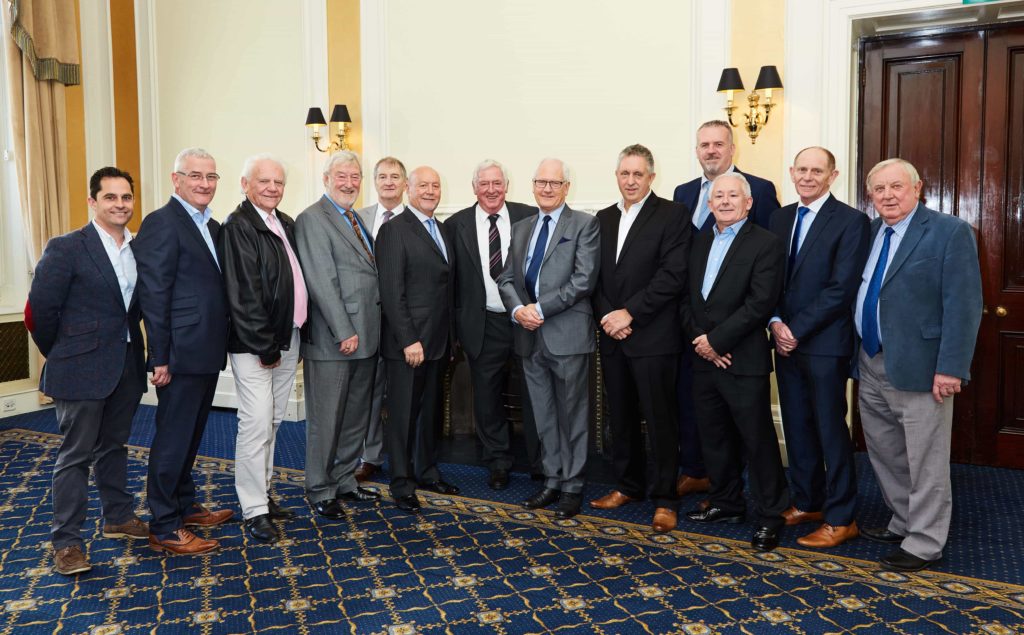
Current president Adrian Jackson welcomed the guests to the event and in particular “some of the legends of the industry.”
Mr Jackson said: “The association was started 40 years ago in January 1975 by six members and it is with great pleasure that I welcome one of the original members of that meeting here today, Brian Perry.”
Commenting on the origins of the association, Mr Jackson reflected that the when the limited company which is linked to the association was formed, it was to “combat the power and the might of the mill sector”.
He reflected on how today the association works on many fronts including also in other material sectors, such as plastics. And, he also described how the association’s membership had changed with the dwindling number of production member businesses. “We are now a much more democratic membership with a wide range of member companies from across the industry, but no matter how large or small that company, the principle of one man, one vote applies.”
Regulators
Mr Jackson also criticised some of the actions of the regulators, with criticism of what is understood to be the Scottish Environmental Protection Agency. He said: “Who could envisage that the actions of one of the environment agencies would lead to companies ceasing to export out of a major area of the UK…
“For me part of the problem is with the word waste, I read with amusement that the boss of Suez does not consider that they make waste anymore as RDF goes for recovery. I am not sure that I agree with that.”
If this applied to waste paper, the sector was actually making recovered fibre and then if it went straight into a paper mill pulper, “surely we are actually making, selling and exporting a raw materials,” argued Mr Jackson.
Strength
The luncheon, held earlier this month at London’s Institute of Directors in Pall Mall, also heard from association chief executive Simon Ellin and from past president and former Cheshire and Palm Recycling managing director, Ron Humphreys.
Mr Ellin said that the association’s strength lay in part in the way it had evolved over the years with developments involving Chinese and UK mills, brokers as well as meeting other challenges. “Therein lies our strengths. It is better for everyone to come together in a trade association rather than everyone being on the outside.”
And, in terms of markets for materials, he emphasised the importance of having a strong domestic market, but that this should not be a monopoly with the export market also important.
Different
Ron Humphreys described how when he went to a first meeting of the association “40 years ago as a 30-year old, I went to a discussion of the status of independent waste paper merchants. The business climate was massively different – there was no export market, no targets, WRAP or other bodies.”
“The business climate was massively different – there was no export market, no targets, WRAP or other bodies”
Ron Humphreys
Recycling Association early member

He noted that there was considerable dissatisfaction because of the way the industry was structured then with power among a small group of mills and merchants which they owned, with some running the industry as their own “business fiefdom”.
“Often smaller independent companies could not supply directly into mills,” Mr Humphreys recalled. “Individually our supplies were not significant but collectively we had a lot to offer.” But, it was not easy when the association first started, he said. “For almost six months, many of the members could not find a door open to them.”
• For a fuller history of the Recycling Association, see the latest copy of Recycling magazine

Register for free to comment