


The annual campaign, which runs from 14 to 20 September 2026, has this year focused on “rescuing” everyday recyclable items from the residual waste bin.
While the campaign has put the spotlight on items including shampoo bottles, aerosols, yoghurt pots and foil, research released alongside the week has highlighted some of the wider challenges facing recycling services.
Waste Minister Emma Hardy commented: “This Recycle Week, I encourage everyone to check the Recycle Now Locator to see what can be recycled in their area and help keep more valuable materials in use for longer.”
Room for improvement in recycling habits
Research for Recycle Week found that 89% of UK households regularly recycle, while just 1% said they never recycle.
However, 38% of people said they could recycle more than they currently do. The proportion of people who believe recycling is worthwhile has also fallen from 81% in 2021 to 69% this year.
The findings suggest that while recycling is an established part of household routines, there remains a gap between participation and the amount of material being captured.
Recycle Now estimates that 2.3 billion recyclable items are put in the general waste bin every year, with 79% of households missing at least two recyclable items per week on average.
Adam Herriott, Recycle Week spokesperson, said: “The fact is, nearly half of all emissions produced globally are linked to the food we eat and the items we make and buy. So, it’s imperative we all play our part in maximising what we get out of them.”
Food waste emerged as another area where there is scope for greater participation. Although 57% of respondents said they receive and use a food waste collection, the research found that general waste remains the dominant disposal route for most food items.
This comes as food waste collections were expanded across England in March 2026 as part of Simpler Recycling.
Recycling beyond the home
The research also suggests that good recycling habits do not necessarily follow people outside the home.
WRAP Cymru found that 94% of people in Wales regularly recycle at home, compared with 61% who said they recycle “very often” at work and just 45% of students who said the same at college or university.
The findings come more than two years after Wales introduced legislation requiring workplaces, educational settings and other organisations to separate key recyclable materials, including paper and card, glass, metal, plastic and food waste.
WRAP said organisations are now putting measures including clearer signage, dedicated recycling facilities and staff and student engagement in place to help bridge the gap.
Councils take local action
Local authorities have used Recycle Week to highlight a range of approaches, from changing collection services to explaining what happens to materials after they are collected.
In Wrexham, the council has announced a package of changes intended to improve recycling performance, with its recycling rate having increased from 60.6% in 2023/24 to 65.1% in 2024/25, but remaining below Wales’ statutory 70% target.
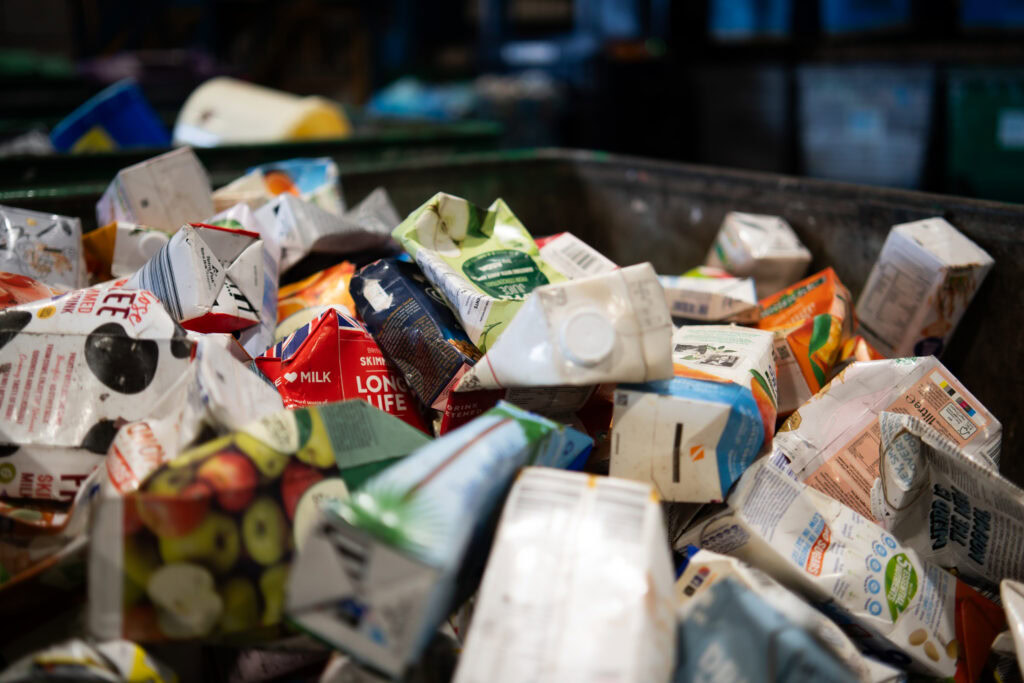
The measures include larger recycling sacks, additional food waste containers and bags, and the introduction of more materials at the kerbside, including Tetra Pak cartons and household batteries. Other measures were more fly-tipping cameras, new route-management technology and the replacement of 20 refuse and recycling vehicles.
Nottinghamshire County Council and Veolia have used Recycle Week to target younger residents, with 1,500 pupils from 47 schools set to take part in educational webinars about recycling.
The partnership also offers schools the opportunity to visit Veolia’s materials recovery facility in Mansfield, giving pupils the chance to see how recycling is processed first-hand.
Wayne Draycott, General Manager for Veolia, said: “By empowering Nottinghamshire’s young people to spark conversations about recycling, we’ll inspire families and communities to reflect on how they manage their waste during Recycle Week and beyond.”
Other councils have used the week to highlight changes to their existing services. Worcestershire, for example, has added toothpaste tubes and foil to its household recycling collections, while Derby has focused on face-to-face engagement through schools, universities and community groups.
What happens after Recycle Week?
The different approaches taken by councils during Recycle Week reflect the range of challenges facing recycling services.
For some authorities, the priority is increasing the materials residents can put out for collection. For others, the focus is on explaining the system, improving participation or addressing behaviour outside the home.
The latest research suggests there is still a sizeable pool of recyclable material that could be captured, despite recycling already being a routine part of life for most households.
For the waste and resources sector, the challenge after Recycle Week will therefore be turning that willingness to recycle into consistent behaviour and ensuring that the services, communications and infrastructure are in place to capture more of the materials currently being lost to residual waste.

Register for free to comment