


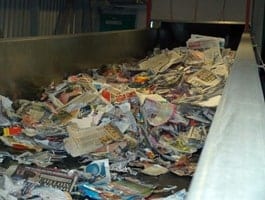
According toGerman researchled by a Swiss government scientist, toxic mineral oils from printing inks in recycled newspapers have contaminated food sold in cardboard containers. Exposure to these oils has been linked to inflammation of internal organs and cancer.
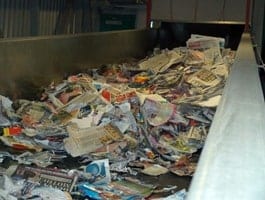
The German research was led by Dr Konrad Grob, from the official food control authority of the canton of Zurich, in Switzerland.
Dr Grob found that the quantity of mineral oil found in recycled paper board used for food packaging regularly exceeded that deemed acceptable by the World Health Organisation. Research on rats has shown excessive amounts of mineral oils can cause inflammation of organs and are also believed to contain carcinogens.
Speaking to letsrecycle.com today, Dr Grob explained that the research had identified the most significant source of mineral oil was newspaper which was used to stiffen recycled paperboard and made up 15-20% of the content of the recycled material.
He pointed to the potential to introduce de-inking processes for the manufacture of recycled paper board to address the problem but said its very demanding and doubtful [that] you can do that at a reasonable price.
He also raised the potential for newspaper mills and other printed matter producers to use inks not containing mineral oils, which he said were widely available.
Dr Grob noted that liners made of PPE plastic and polyethylene would not provide a barrier to mineral oils. However, he said aluminium foil wrappers would create a barrier, but, noting this was not an environmentally friendly solution, he instead highlighted the potential for using PET instead. He added that this plastic could also be used to coat the paperboard to have a similar blocking effect.
CEPI
Responding to the Swiss-led study, Teresa Presas, managing director for the Brussels-based Confederation of European Paper Industries (CEPI), told letsrecycle.com that mineral oils existed naturally in the environment and that concerns only arose when it was found in high concentrations. She said that it was most commonly used in offset printing but that many packaging producers were phasing it out.
Ms Presas explained: Germany is phasing out the use of mineral oils in printing inks used on packaging and working with the ink manufacturers there has to be a tight collaboration. This is something we are seeing more of. Vegetable oil-based inks are an alternative but are not yet widespread and to replace them all will take time.
Inthe meantime, she said, papermakers would be looking to find their own solutions and would be looking to optimise the fibre mix and added: We have to minimise the risks but its not about excluding the use of newspapers we have to optimise the fibre mix. It is a matter of looking for solutions to eliminate substances.
Ms Presas pointed to industry guidelines published recently on the production of board which comes into contact with food as evidence that standards were constantly being raised.
UK view
In the UK, David Workman, director general of theConfederation of Paper Industries (CPI) which represents paper mills in the UK – said that this was the first time he was aware of any major health concerns regarding minerals oils in recycled packaging but that it was important people did not stop recycling.
Speaking to letsrecycle.com, he said: We are taking this very, very seriously and are working with the Food Standards Agency in the UK, and expecting the European Food Safety Authority (EFSA) to issue a report in September. We will be working with the manufacturers across Europe through CEPI to advise them of the impact of using mineral oil based inks.
We want people to continue to recycle paper products in the same way as they have been doing as it is a real success, with a Europe-wide paper recycling average now of 72%. What we dont want to do is give out the impression that they shouldnt continue to recycle paper.
There is always a danger that something like this in the media, especially if the effects are over-emphasised, could have an effect on confidence and there is concern that this might happen. We really want to encourage people to continue recycling as they have been doing and we are working to eliminate these [mineral oil-based] inks.
Recycling Association
Simon Ellin, chief executive of The Recycling Association which represents many independent waste paper reprocessors said that there were often challenges for recyclers and it was important for the recovered paper sector to work with the Confederation of Paper Industries (CPI) and to help engineer out any problems which were a concern to manufacturers.
He said: There are two ways around it. We either work with the manufacturers to ensure that this is engineered out of the materials so this alleged contamination doesnt enter material, or work with our members to ensure that the right mix of recycled materials is used and this alleged contamination is not in the supply chain.
Mr Ellin explained that reprocessors could look at preventing mineral oils entering the process or change the supply material for recovered card which typically includes an element of mixed paper. He added: Certainly our aim would be to work with both the supply chain and manufacturers.
Food Standards Agency
For its part, The Food Standards Agency told letsrecycle.com that it was not particularly concerned about any risk to health suggesting the Swiss-led study was incomplete.
An FSA spokesperson said: The FSA is not aware of any firm evidence to suggest that there are food safety risks related to mineral oils in recycled food packaging.
The German research is interesting, but due to incomplete data the results have not demonstrated that mineral oils in food packaging represent a food safety risk.
The FSA added that it was currently gathering information on of the presence of mineral oils in food packaging on the UK market.
It said: The Agency is also specifically looking at recycled material to ensure that manufacturing processes successfully remove substances that could present a food safety concern from the finished packaging. Manufacturers are responsible for ensuring the food they produce is safe, and some have chosen to review their use of recycled packaging. The Agency continues to review evidence in this area and will act to protect consumers if the evidence shows it is necessary to do so.
FDF
The Food and Drink Federation (FDF) which represents food manufacturers in the UK said it was aware of recent studied looking at the potential presence of mineral hydrocarbons in food from recycled cardboard used in food packaging but noted that this was limited and it was working with other stakeholders to get more information.
Barbara Gallani, director of food safety and science at the FDF, said: The Food Standards Agency has indicated that there is not a need for immediate action. It is carrying out a survey of food packaging materials including recycled cardboard and will report back in the summer. In the meantime FDF has revised guidance for food manufacturers on recycled carton board in food packaging.
The FDF said it had not yet published the guidance but that it addressed the issue of food safety.
The FDFs position was echoed by cereal manufacturer Weetabix which currently uses 100% recycled board. A spokesman for Weetabix said: Currently there is no cause for alarm, there is no evidence that consumer health is at risk but is an industry-wide issue that goes across all food and drink, anything that is using recycled newspaper in packaging, as it is the ink that is the issue.
Kelloggs
However, cereal manufacturer Kelloggs said it was taking a more cautious approach.
A spokesman said: While experts tell us theres no immediate health concern, we are looking at our packaging. We are working with our suppliers on new packaging which allows us to meet our environmental commitments but will also contain significantly lower levels of mineral oil. We are also looking at alternative inner liners for our packets.
Whilst there are strict regulations when it comes to the packaging of food, there is currently no direction from the UK government about mineral oils. We will immediately follow any such guidance once it has been given.
For its part, Jordans said it would also consider using recycled cardboard in future if no newspapers had been used to produce it.
A spokesman said: We will be discussing improved supply of recycled board that avoids content from newspapers with the industry and our suppliers.
WRAP
The Waste & Resources Action Programme (WRAP) the governments recycling body said that it could not comment about safety.
However, it made the following statement: The specialist issue of food contact safety in packaging is beyond the realms of our expertise at WRAP so it would be inappropriate for us to comment on that particular matter.
“However, it is important that the cardboard, like many other packaging materials, should contain the right amount of recycled material while still being functional. It should also be easily recycled at the end of its useful life. Through measures like this, our Courtauld Commitment signatories aim to reduce the carbon impact of grocery packaging by 10% by 2012.



Register for free to comment