


OPINION: Let’s be honest, nobody wakes up thinking, “I’m going to contaminate my recycling today.” People are juggling busy jobs, replying to WhatsApps, trying to get dinner on the table and remembering to hang the washing out. Recycling decisions happen in the middle of real life, not in an ideal world where everyone has time to check the council website or read another leaflet.

That’s why I don’t think the recycling sector has an information problem. I think it has an attention problem.
This feels especially important now. With Simpler Recycling and Extended Producer Responsibility (EPR) bringing more consistent collections and significant investment in council communications, we have a genuine opportunity to rethink how we engage residents. But those reforms won’t deliver their full potential if people continue to scroll past, walk past or tune out the messages designed to support them.
At Hubbub, we’ve spent the last decade testing what genuinely helps people recycle better. One lesson comes up time and again: more information isn’t always the answer. What people need is a simple message and a reason to pay attention.
The challenge is that recycling campaigns are competing with Instagram ads, crying kids, breaking news, streaming services and the hundred other things demanding our attention every day. In that world, another leaflet full of recycling “dos and don’ts” simply isn’t enough, particularly for the audiences we need to engage the most.
We wanted to know what would happen if a recycling campaign borrowed a few tricks from the things people actually engage with, so we teamed up with Lambeth Council and Ecosurety to test it out with our Can We Talk Dirty? campaign in Brixton.

Food waste accounts for around 30% of Lambeth Council’s recycling contamination, spoiling other materials and increasing disposal costs. Unlike the occasional rogue toaster or frying pan, food contamination is an everyday behaviour, making it a much bigger opportunity for impact.
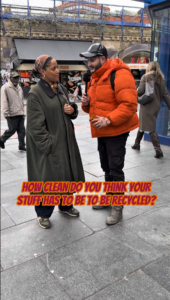
Our research found that residents were willing to recycle, but they were unsure about contamination. How clean does packaging need to be? Does a quick rinse really matter?
But instead of another campaign packed with recycling instructions, we leaned into the fact that food waste is, well… a bit gross. We talked about grease, slops, leftovers and gunk, using humour and playful language to make people stop and look twice. In practice, that looked like bold pink visuals, a deliberately provocative name and vox-pops on the streets of Brixton “talking dirty” with Lambeth residents.
One resident later told us: “I was walking with my husband and we were having a conversation and we both stopped and looked at the billboard.”
That might not sound revolutionary, but it’s where behaviour change starts. Before someone remembers to rinse out their packaging, they have to have the idea in their head in the first place.

Creativity isn’t enough on its own, which is why every decision was grounded in behavioural insight, focused on one audience and one clear action. Confidence about what could be recycled increased, more people reported emptying and rinsing packaging before recycling and sampling suggested contamination fell across two of the three target collection rounds.
The lesson isn’t that every recycling campaign needs humour, innuendo or a giant tin of sloppy beans. It’s that we should spend less time thinking about everything we’d like to tell people and more time thinking about the one thing we need them to notice, remember and do. In this case it was as simple as six words: “Keep it clean to make it count”.
As councils embed Simpler Recycling, there will naturally be a focus on explaining the new rules. But alongside EPR funding, it provides an opportunity to be much bolder about how we communicate them. Whether that’s humour, trusted community voices or local storytelling, the creative approach will look different for difference audiences.
Instead of asking “What do residents need to know?”, a more useful question might be “Why would they stop and pay attention?”
Because once we’ve earned those few seconds of attention, the information itself becomes much more powerful. If we treat communications as a core part of successful recycling services, rather than the finishing touch, we won’t just be giving residents better guidance – we’ll be giving them a much better chance of acting on it.
For more information about Hubbub and the Can we talk dirty? campaign, visit: hubbub.org.uk/can-we-talk-dirty.

Register for free to comment