


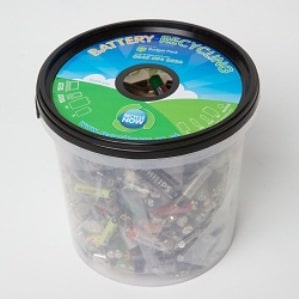
Battery collection points rolled out to 500 Dixons stores
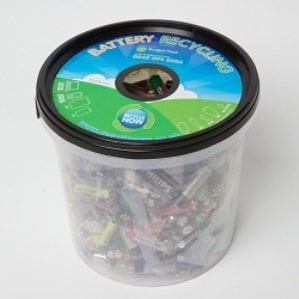
Budget Pack has delivered over 1,000 battery recycling containers and information packs to stores and contact centres throughout the Dixons group – replacing the old slightly tired containers that were in place before. Dixons Retail will also receive on-demand waste battery collections, a dedicated telephone support line and regular data reports tracking the environmental impact of the scheme.
Steve Clark, chairman of Budget Pack Environmental, said: We are delighted to be working with Dixons Retail and are pleased we could offer the customer-focused approach they were looking for.
We are expecting to collect 30-40 tonnes of batteries per year from the new collection points. This is a substantial volume of hazardous waste that, as a result of the scheme, will now be recycled rather than ending up in landfill.
Christopher Brown, Recycling Process and Compliance Manager at Dixons Retail, said: Through our work in supporting the WEEE Directive, we are proud to already offer our customers a free nationwide electrical recycling scheme. On delivery of a new product, any old electrical items are taken away and our customers also have the option of calling in at any Currys or PC World store where we offer in store take back of old electrical items. We are committed to minimising the environmental impact of our business and we are pleased to provide these new battery recycling facilities for our customers.
Under UK law, retailers which handle more than 32kg of batteries per year are obliged to set up battery collection points and allow customers to recycle batteries free of charge.
Covanta attracts interest from variety of sources
Energy-from-waste operator Covanta has said it is confident of finding a buyer of partner for its UK assets after receiving interest from a variety of sources.
Last month, the company announced that it was seeking a buyer or partner for its UK business after failing to secure a lucrative local authority waste contract on Merseyside (see letsrecycle.com story).
And, this week the companys newly-appointed managing director, Fiona Penhallurick, said that while negotiations were still in the early stages, the signs so far were positive.
She said: There has been interest from a variety of sources. There is nothing that we can disclose at the moment because negotiations are at an early stage but suffice to say there are opportunities.
Commenting on what would happen if the company could not find a buyer she said: Given the amount of interest we have had we don’t consider [not finding a buyer of partner that to be a likely outcome.
Minister praises Sandwells weekly waste service
Sandwell councils waste partnership with Serco has been praised by a Government minister.
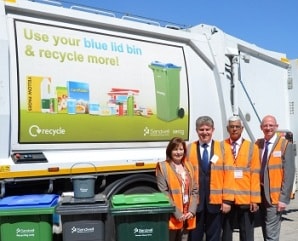
Sandwell Council appointed Serco to deliver its waste, recycling and street cleansing services in 2010. Since then, the partnership has overseen a number of improvements, providing residents with weekly domestic, recycling and food waste collections as well as fortnightly garden waste collections.
Household recycling rates in the borough have rocketed as a result, rising from 39% to around 50%. Under the partnership, customer satisfaction levels have also increased to more than 90%.
Speaking during his visit Mr Lewis said: Every household in England has the right to have their rubbish taken away each week – it is the most visible council service people get.
Sandwell has shown that the Government’s Weekly Collection Support Scheme is helping councils keep weekly bin collections whilst boosting recycling, cutting waste and by introducing innovative reward schemes such as ‘Go Green’.
Councillor Maria Crompton, Sandwells cabinet member for highways and environment, said: We welcomed this opportunity to show Mr Lewis around some of our excellent new facilities. Were extremely proud of our partnership with Serco which is not only boosting our recycling rates but helping us avoid millions in landfill tax.
Smaller portions could cut food waste, research shows
Pubs, hotels and restaurants could help prevent food waste and save money by offering customers greater meal choices and smaller portion sizes.
That is the headline finding of new research launched this week by WRAP which looks at consumers attitudes and behaviour around food waste. The research found that more than half of customers leave food uneaten because portion sizes are too big or they have ordered too much when eating out.
The research shows that the areas providing significant opportunity for the sector to save money and reduce waste. Around 53% of customers surveyed said they would like to see more choice and 44% stated large portions were actually off putting. The most wasted food is often the side dishes of chips, vegetables and salad, so businesses can save money by asking whether these are actually wanted.
It is estimated that pubs, hotels, restaurants and quick service restaurants could save an estimated 722 million a year by preventing food waste and increasing recycling.
Industry is already taking action with over 150 companies signing up to WRAPs Hospitality and Food Service Agreement (HaFSA) which launched in June 2012. It is a voluntary agreement to cut food and associated packaging waste by 5% and increase recycling to 70%.
Richard Swannell, director at WRAP, said: By highlighting consumer attitudes there is an opportunity for industry to create practical solutions to the problem. WRAP is working with industry to tackle food waste through the Hospitality and Food Service Agreement, the on-line resource pack and a recently established industry working group to look at menu planning and portioning.
SITA launches food waste service in Birmingham
SITA UK has launched a food waste recycling service for businesses in Birmingham.
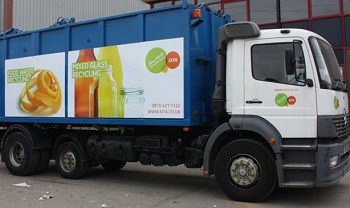
The new service has been introduced following a grant from the Waste and Resources Action Programme (WRAP). The grant of 52,000, which has been matched by SITA UK, will allow businesses to recycle food and glass in a brand new vehicle and could help to over 1,000 tonnes of waste from going to landfill every year.
Andy Hill, head of organics and alternative fuels at SITA UK, said: As the UKs second city, Birmingham is full of businesses that are looking for ways to improve their environmental performance and reduce their carbon footprint. Recycling food waste is an easy way to achieve this aim and to ensure that a significant proportion of your waste is diverted from landfill.
This service has proved very successful in London, where we are collecting food waste from over 800 customers and putting that waste to good use by creating compost. We have already spoken to a range of companies in Birmingham and know that many are keen to introduce food waste recycling to help boost their green credentials.
Customers using the service are provided with kitchen caddies lined with bio-degradable sacks known as biobags. Once a caddie is full, the biobag is fastened and put into a larger container, which is collected at least once a week. The food waste is then sent to an anaerobic digestion plant in Wolverhampton where it is turned into digestate and biogas for the generation of renewable energy.


Register for free to comment