
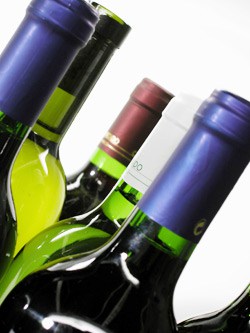
The organisation announced this week its major initiative to increase the recycling of waste glass in the UK by working with the wine industry.
 WRAP hopes more wines could be bottled in the UK to increase demand for recycled green glass |
WRAP has identified two major directions for its work – minimising the weight of glass used to make each wine bottle, and persuading wine producers to have their wines bottled in the UK.
On this latter point, WRAP's Andy Dawe said if the bottling process is done in this country, there would ultimately be less green glass imported into the UK, while demand for recycled green glass within the UK would increase.
The work would aim to tackle the imbalance between the amount of green glass used by UK container manufacturers and the amount of green glass arising in the waste stream.
“Because we consume a lot of wine, but we don’t produce many green bottles in this country, the domestic market for recycled green glass can struggle to keep pace,” explained Mr Dawe, WRAP’s material sector manager for glass, who is heading up the wine bottle initiative.
WRAP believes suppliers outside the traditional wine producing areas of Western Europe are more likely to send their products to the UK in bulk to be bottled, than traditional European wine producers such as France.
Australia
Mr Dawe told letsrecycle.com that the emergence of countries such as Australia – now the biggest country of origin for wine consumed in the UK – and Chile as major wine providers had allowed the idea to be seriously considered. Wines from the New World now account for 50% of UK sales.
He said: “The emergence of new world countries has allowed this work to take place. If we concentrated on traditional wine makers in Europe it would be a much more difficult task.”
Mr Dawe explained that many countries did not have the bottling capacity, and would actually benefit from exporting bulk wine to the UK.
Around 20% of wine bottles are already bottled in the UK according to WRAP, and Mr Dawe added: “Our research shows that an additional 10% switch would mean 55,000 tonnes less glass imported and a rise in demand for recycled green glass in the UK of 50,000 tonnes.”
Lightweighting
Meanwhile, regarding the lightweighting of glass packaging, WRAP said it is aiming to speed up innovation by supporting companies like Coors Brewers Ltd, which has successfully cut the weight of its Grolsch bottle by 13%, saving the use of 4,500 tonnes of material each year.
| Related links: |
This work – called the Container Lite project – has been supported by WRAP's waste minimisation innovation fund. WRAP’s head of innovation, Richard Swannell, said: “The project has shown that many existing food and drink bottles can be lightweighted without affecting packaging performance or product sales.
“This reduces material and energy costs bringing benefits to manufacturers, retailers, consumers and the environment. For the wine industry, where the weight of a 75cl bottle can vary between 300g and 800g, the potential for cost and waste reductions are large,” Dr Swannell explained.


Register for free to comment