

Waste and recycling industry members have been debating the state of treatment infrastructure and the forecasted levels of municipal and commercial and industrial (C&I) waste arisings in England.
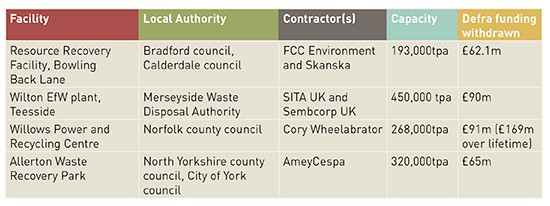
The discussion follows a series of exchanges over the issue in recent weeks, following Defras withdrawal of 169 million of PFI funding for Norfolk county councils contract to build a 268,000 tonnes-per-year capacity energy-from-waste (EfW) plant in Kings Lynn (see letsrecycle.com story).

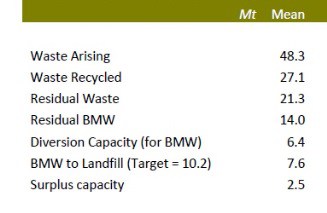
The government predicts that even without the Norfolk EfW going ahead, England still has a 95% likelihood of meeting or exceeding EU 2020 landfill diversion targets, with approximately 2.5 million tonnes more treatment capacity than needed to do so.
Under the EU Landfill Directive, the UK must reduce biodegradable municipal waste (BMW) landfilled to 50% of the 1995 level by 2013, and to 35% of the 1995 level by 2020.
The Chartered Institution of Wastes Management (CIWM) has also warned of a potential 15 million tonne treatment capacity shortfall for commercial & industrial (C&I) waste by 2020, in a report published last month (see letsrecycle.com story), pointing out that investors are cautious of infrastructure projects due to a lack of accurate data over the waste stream.
The funding withdrawals have also raised concern at waste sector trade body the Environmental Services Association (ESA).
 table of England waste arisings forecasts for 2020.jpg)
And, commenting on the Institution’s report, ESA said: CIWMs recent investigation into the C&I market showed that we are likely to be heading for an overall shortfall in alternative capacity to landfill by 2020. The government has missed a trick by not helping local authority-backed projects to develop merchant capacity which might have alleviated some of this shortfall.
ADEPT
Local authority senior officer’s group, the Association of Directors of Environment, Economy, Planning & Transport (ADEPT), has spoken out against Defras PFI funding withdrawals. ADEPT has said that household waste arisings are increasing and that the UK is at risk of missing 2020 landfill targets due to inadequate infrastructure capacity.
And, speaking to letsrecycle.com, chair of ADEPTs environment board Rupert Clubb, said: Now it is a case of taking stock. People have different views on the data. Some people have some concerns that we wont have the capacity, while others say we will have the capacity and there is nothing to worry about.
It is important to understand that it is never as clear cut as having one data model that everybody uses. How can we do that in a way which recognises that all these different organisations have different goals and objectives?
Mr Clubb said that ADEPT was shortly to begin talking with other industry organisations, including CIWM, to try and work towards finding a consensus over the state of waste arisings and capacity in England.
Defra PFI funding withdawals in 2013
SITA UK
Waste management company SITA UK has also given its support to the view of CIWM that the overall data on C&I waste arisings is very poor, but the firm has done its own modelling on C&I waste since 2008 and has several hundred thousand data sets from its customers.
Stuart Hayward-Higham, development director at SITA UK, told letsrecycle.com: We have a better picture than most, we think, on C&I waste arisings and probably have slightly more information than Defra does on this.
Our own view, on the laws of probability, is that waste arisings will continue to increase. C&I waste has historically been quite linked to GDP growth growth will drive C&I waste.
Commenting on municipal waste infrastructure, Mr Hayward-Higham said: You are talking about the beginning of the end of large waste treatment infrastructure. What we do need though is significantly more capacity in the C&I sector. But financing that is a challenge and without data it is very difficult to manage that.
Eunomia
Consultancy Eunomia publishes its own regular reports on capacity for residual waste treatment, including one in December 2012 which claimed the UK as a whole was at risk of heavily over-investing in residual waste treatment infrastructure. With regards to C&I waste, chairman of consultancy Eunomia, Dominic Hogg, also felt that more, and better quality, data was needed for the waste stream.
However, Mr Hogg said that the CIWM report on C&I infrastructure hasnt convincingly demonstrated a capacity gap as it didnt take account of all sorts of treatments in C&I that could be used to deal with the full range of different waste streams.
He noted that the picture painted by the CIWM report for 2013 seemed inconsistent with the prevailing reality, and the available data regarding landfilled waste and added that where residual waste treatment was concerned, the CIWM/Ricardo-AEA report seemed to be reaching a similar conclusion to Eunomia in respect of potential over-capacity in future.
Mr Hogg told letsrecycle.com: When you look closely at the figures, they are actually saying more or less the same thing that we are. We think the conclusion conveyed in the report that there is too little treatment capacity in place for the future more generally is highly debatable given the assumptions underpinning their view as to how much waste might need treatment, and the fact that the list of treatments whose capacity they review is not comprehensive, given the nature of the wastes they were considering.
Dominic Hogg has also contributed an opinion piece for letsrecycle.com, which can be viewed here.

Register for free to comment