

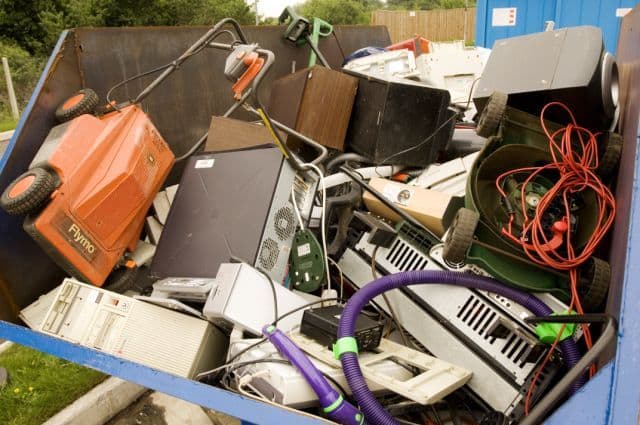

The proposed reduction comes on the back of official statistics which showed that UK producer compliance schemes (PCSs) missed their target for 2017 by more than 15%, collecting a total of 522,901 tonnes of WEEE.
A proposed overall UK WEEE collection target for 2018 has been provisionally set at 532,818 tonnes, 9,917 tonnes higher than the total amount of household WEEE collected by PCSs last year. The figures come in draft documents from the Department for Environment, Food and Rural Affairs.
The possible 532,818 tonnes target for 2018 is also almost 100,000 tonnes lower than the 2017 target of 621,990.
The target for 2018 is out for discussion now. Last year the target was reduced by more than 10,000 tonnes compared to the initial proposed figure (see letsrecycle.com story) after it was consulted on. Compliance schemes will now have an opportunity to review the targets and respond before they are finalised.
Methodology
The methodology for calculating the targets is based on the average annual growth in tonnes of WEEE collected for each category since 2013, while also considering the EEE placed on the market.
WEEE collected by schemes and reported to the environment agencies is used as the source data.
An additional factor Defra must also consider is the impact of a change of definition of household WEEE since 2014. This enables collections of business WEEE to count towards targets if items “are similar to that which is sold to householders”. This is known as dual use equipment and includes lighting, ICT equipment and lamps.
The change led to an alteration in the methodology for some targets, including a three year trend for lamps and LED sources, instead of the traditional five.
Categories
As the below table outlines, each category has seen a proposed reduction in targets, with the most significant in those over 100 tonnes being for large household appliances, monitoring control appliances and display equipment.
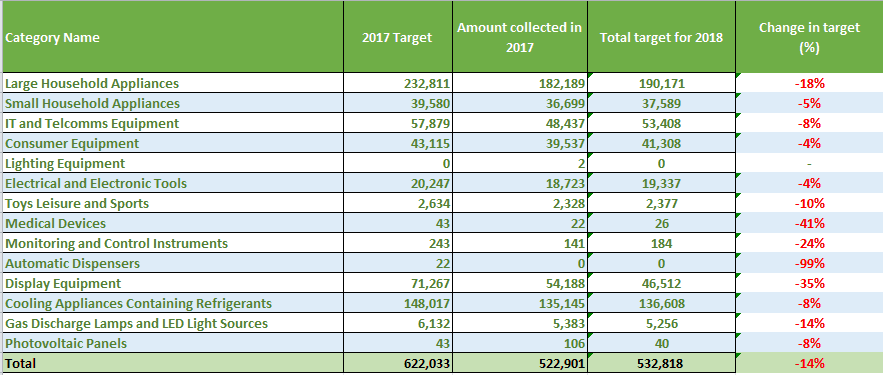
For display equipment, Defra says the weight has been in decline over recent years as a result of a move towards lighter flat-screen products. This is reflected in lower collection targets year on year. The 2018 proposed target follows this 5 year trend data.
Schemes are currently in the process of talks with Defra over the changes, with a final decision expected later this month.
Directive
The overall target is below the collection levels necessary to achieve the UK Member State target of 768,211 tonnes for 2018.
The gap between the Member State target and collection data submitted under the WEEE Regulations will be met from other sources of WEEE, including non-household collections and “substantiated estimates” of WEEE arising and treated from other sources, notably LDA that appears in the light iron waste stream.
Many compliance schemes have said that the UK remains on target to meet EU targets once substantiated estimates are taken into account, pointing to a study which has shown that up to 10% of scrap metal can be counted as large household appliances. This would be an extra 500,000 tonnes, it has been suggested.
Reaction

Responding to the draft Defra collection targets, Mark Burrows-Smith, chief executive of the compliance scheme REPIC, said he agreed with the overall targets so far. He said: “Defra’s methodology of using the 2017 collection data as a starting point is sensible – especially considering that EEE placed on the market fell in 2017. It is important that targets are challenging yet reflect current market dynamics.”
Mr Burrows-Smith concluded that REPIC is currently preparing its consultation response, along with all other compliance schemes before the final figure is released, expected to be later this month.
Electrolink
Paul Van Danzig, sales and marketing director at Electrolink, which says it met all 2017 targets through traditional routes, said the reduced targets send out the wrong message.
“It’s disappointing they have dropped from 2017. Whilst the new targets do represent a small increase, it is less than 10,000 in real tonnage. Only time will tell whether they have been set at the right levels. Moving on, we should be looking at some big questions and benchmarking our performance against the percentage placed on the market.”
_______________________________________________________________________________________
WEEE Conference
6 June 2018, Cavendish Conference Centre
WEEE collection rates and progress towards future targets will be among the topics covered at the 2018 WEEE Conference. Join us to debate these issues and more.


Register for free to comment