

This represents a drop of about £3 million from the last financial year where it sat at £489 million.
Landfill tax receipts have largely been decreasing each year.
David Gudgeon, head of external affairs at Reconomy Connect, said: “It is encouraging to see landfill tax receipts continuing to fall. This suggests that businesses are making better use of their materials, focusing more on recycling and reuse, and are diverting waste away from landfill.”
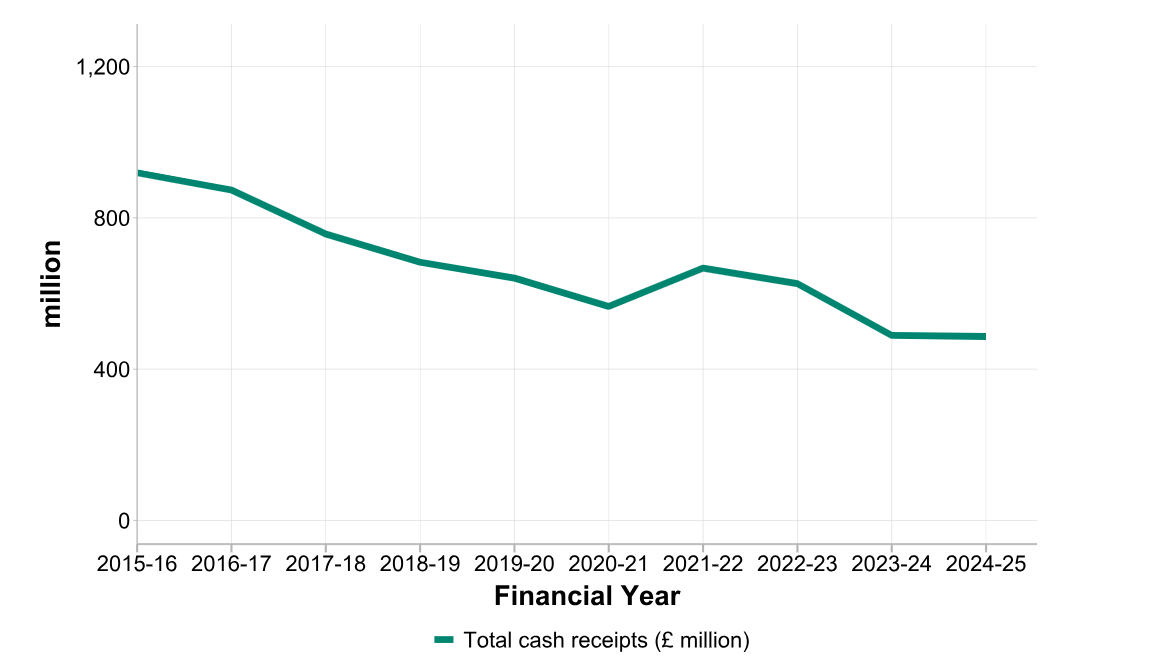
In the financial year ending 2022, the receipts increased compared to the previous year which HMRC attributed to the COVID-19 pandemic. Receipts have returned to a decreasing trend in the financial years since.
Introduced in 1996, the tax is paid by landfill operators on the disposal of material at a landfill site.
The tax is passed onto businesses and local authorities through the gate fee for disposing of waste at a landfill.
Up until 2015, HMRC said the tax was the largest environmental levy.
It noted that in 2013/14, landfill tax receipts were £1.189 billion, meaning they have fallen by over 50% in 10 years as more energy recovery capacity has come online.
Gudgeon added: “However, we are still a long way from becoming a truly circular economy. The latest data shows that the circularity gap in the UK is currently 7.5%, meaning that the vast majority of secondary materials don’t re-enter the economy.
“With a number of transformative environmental regulations on the horizon, businesses that prepare early, view waste as a resource, and prioritise reuse and recycling over landfill, will be best placed to mitigate rising cost pressures, lower their carbon footprint, and contribute to a more waste-free, sustainable world.”
The data also provisionally showed that landfill tax tonnage was down in the financial year ending 2025.
In keeping with the receipts, landfill tax tonnage showed a small rise in the financial years ending 2022 and 2023 but has continued to decrease since then.

Register for free to comment