

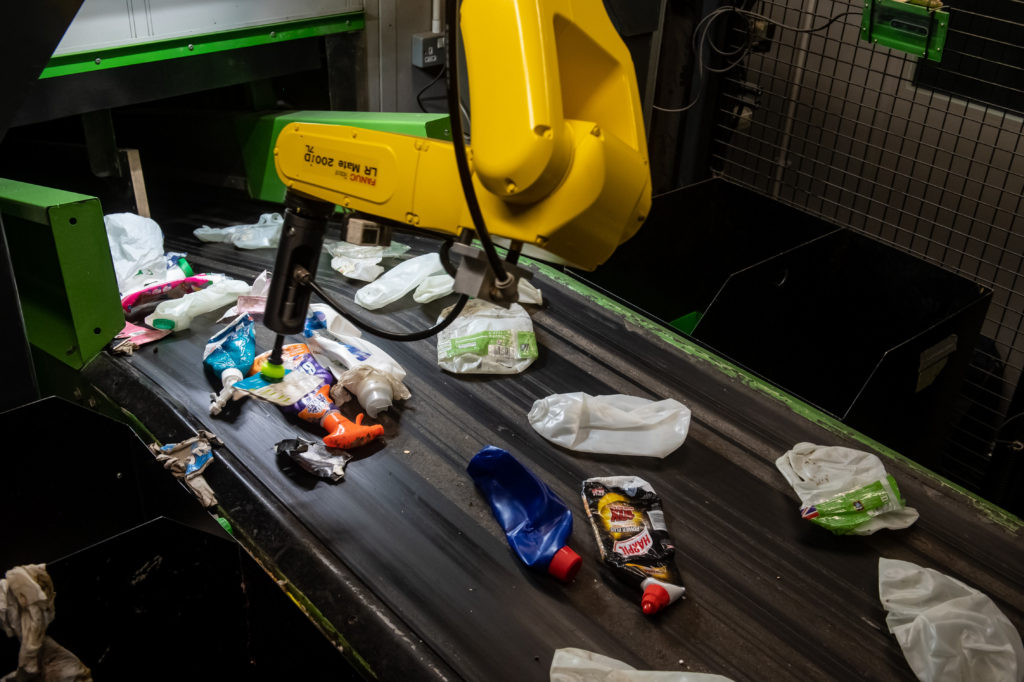
The National Waste and Recycling Robotics Adoption Hub (NORAH), funded by Innovate UK, is one of eight robotics adoption hubs being established across the UK to help businesses and public services introduce automation.
The £3.6 million project, which includes £1.5 million for Kingston University, will support waste and recycling sites to test and adopt robotic technologies.
Led by Professor Vasilis Argyriou, the hub will focus on helping operators deploy automation in waste environments, where contamination and the unpredictable nature of materials can make robotic sorting difficult.
Fewer than 5% of UK waste facilities have adopted automation, according to the project, with some robotic systems struggling to operate reliably when handling contaminated, mixed and deformable materials.
This has made it difficult for operators to predict how systems will perform, assess their return on investment and make decisions about deploying the technology.
Professor Argyriou commented: “The National Waste and Recycling Robotics Adoption Hub will help UK recyclers move proven robotics from the lab into live operations, keeping valuable materials out of landfill, cutting carbon emissions, creating skilled jobs and accelerating the circular economy.”
Testing and adopting robotics
NORAH will enable robotic systems to be tested and validated using real waste streams, initially focusing on complex materials such as textiles, mixed recyclables and soft-material waste.
These materials present particular challenges for existing sorting systems, but also offer opportunities to improve recovery rates and productivity.
The hub will use advanced sensing systems, multi-arm robotic sorting cells and digital simulation to assess technologies on live, contaminated waste streams.
Testing will generate performance data on factors including classification accuracy, throughput, contamination handling and material recovery. This will be combined with economic modelling tailored to individual sites to help operators assess potential payback periods and investment requirements.
Services offered by the hub will include independent benchmarking using waste samples supplied by operators, alongside support for integrating robotics into materials recovery facilities (MRFs) and existing infrastructure.
The project will also provide training and workforce transition programmes focused on the safe operation of robotics in contaminated environments.
Innovation programmes will address specific industry challenges, including mixed-fibre sorting, contamination removal and automated disassembly.
Operators will also be able to access local authorities and commercial waste facilities to support the testing and deployment of technologies in live operating conditions.
The project will be led by Kingston University, with the University of Kent and the West London Waste Authority among the consortium members, alongside robotic developers, waste operators, local authorities and national bodies.
The hub will combine research with practical deployment and policy engagement, with the aim of ensuring technologies meet industry needs, regulatory requirements and the demands of wider adoption.

Register for free to comment