

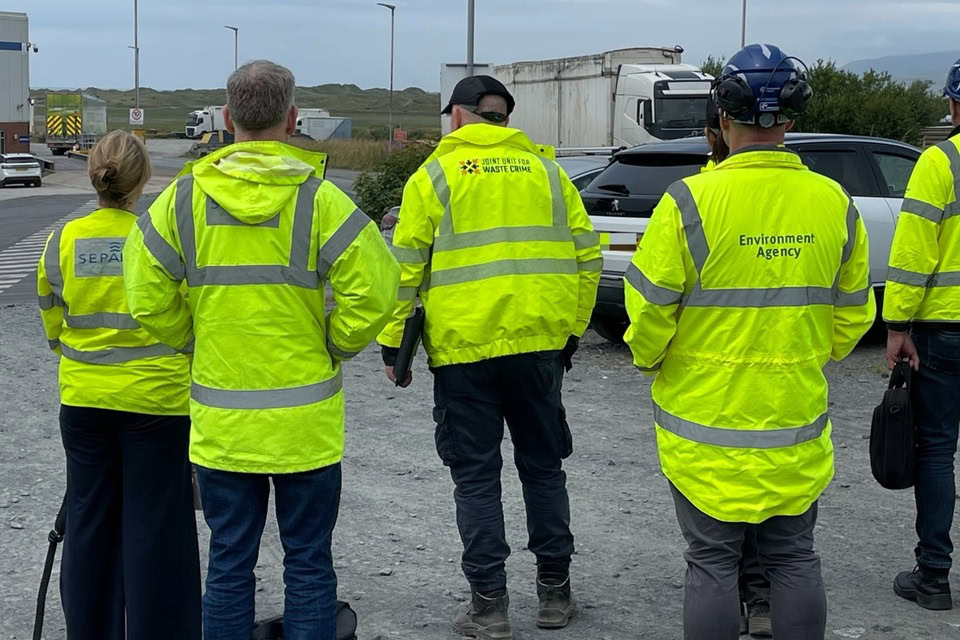
Published yesterday (29 July 2026), the report outlined the work of the multi-agency taskforce, which was established to tackle serious and organised crime in the UK’s waste sector.
It showed that the JUWC led 23 operations and supported a further 38. It also coordinated or attended 59 multi-agency days of action, resulting in 13 arrests by partner organisations, eight vehicle seizures and 17 interviews under caution.
The figures relate to the work of the JUWC’s 14 full-time Environment Agency crime officers and do not include the wider partnership’s enforcement activity.
The report also revealed that the JUWC received funding to recruit eight additional staff during the year, increasing its full-time workforce from 10 to 18 officers.
It said that the expanded team will aim to improve geographical coverage, increase capacity to investigate organised crime groups and strengthen collaboration with policing and economic crime partners.
Responding to the report, ESA’s Head of Regulation, Sam Corp, said: “Today’s annual performance report demonstrates a marked and welcomed increase in effective enforcement behaviour to disrupt and deter the criminals blighting our sector, communities and the environment.
“Criminals adapt quickly, so it is imperative that regulation and enforcement partners are adequately equipped and resourced to maintain this momentum across a range of interventions—from working with waste producers to prevent waste from falling into the wrong hands, to pursuing major enforcement operations and prosecutions of the kind outlined in today’s report.”
Organised crime focus
The JUWC’s primary focus was on organised crime groups (OCGs) that pose the greatest risk to the waste industry.
According to the report, criminal groups are increasingly operating like legitimate waste businesses, adapting their methods to establish and control illicit markets while gaining influence within the legitimate sector.
Rather than relying solely on prosecutions, the JUWC said it has increasingly focused on disrupting criminal activity through financial investigations, permit suspensions, vehicle seizures and other enforcement measures designed to make offending “physically and financially impossible” to continue.
There are currently 21 criminal and civil investigations and two major crime investigations linked to JUWC operations, with a number of prosecutions under consideration.
JUWC enforcement activity
The report highlighted disruption activity against organised crime groups through measures including deregistration of waste carrier licences, account freezing orders, permit suspensions, removal of waste exemptions and the refusal of Packaging Recovery Note (PRN) accreditation.
The JUWC also participated in 10 roadside enforcement operations during the year, including checks on waste carriers at the Scottish border and a multi-agency day of action in Kent, where 14 vehicles were stopped, one arrest was made and several drivers came under investigation.
The report says the unit has also strengthened its intelligence and enforcement capabilities by training two officers as drone pilots to help identify illegal waste sites, while more than 4,000 enforcement officers have received training on the Scrap Metal Dealers Act through the British Transport Police.
Last week, the Environment Agency announced the end of its 18-week Operation Unite campaign which resulted in 17 environmental permits being suspended or entering the revocation process.
The National Waste Crime Conference takes place on 3 November 2026 in London. The one-day event will bring together professionals from across enforcement, regulation, local government and the waste industry to examine the challenges posed by waste crime and the sector’s response to the new regulatory landscape. Find out more and secure your ticket here.

Register for free to comment