

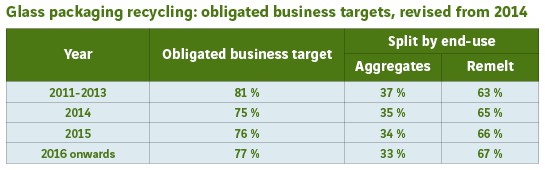
The glass packaging recycling target will be reduced to 75% this year from 81%, the Department for Environment, Food and Rural Affairs announced today (March 20). This target will then rise 1% per year up to 2016, when it will recach 77%.

Defra has also opted to amend the split between remelt and aggregate from this year to 65% and 35% respectively. From 2015, the remelt target will then increase to 66%, and then again to 67% from 2016 onwards, with the aggregate target reducing by one percentage point over the next two years in line with this.
According to Defra: “The targets reflect new and better evidence of both the total levels of glass packaging being placed on the market/available for recycling, and the proportion available for remelt.”
The targets will apply retrospectively for the compliance year 2014, with Defra planning to bring the regulations into force in autumn 2014.
In addition, the 2014 targets will be supported by an Environment Agency Regulatory Position Statement (RPS), which will clarify that producers are expected to achieve the new targets. The Agency will not take enforcement action against producers that do not achieve the regulatory target of 81%.

The business targets are an essential part of the calculations on the National Packaging Waste Database (NPWD) in order for the UK to comply with the EUs overall glass recycling target of 60%.
The EU target includes both business and local collection glass recycling rates, the latter of which is currently 68%, althoughDefra said today that it would also be amending this domestic target to better reflect more up to date industry data.
‘The targets reflect new and better evidence of both the total levels of glass packaging being placed on the market/available for recycling, and the proportion available for remelt.’
UK government
Consultation
Todays decision to amend the business targets follows the Advisory Committee on Packaging’s report in October 2013, which suggested that the amount of glass on the UK market had been overestimated (see letsrecycle.com story).
As a result, Defra launched a stakeholder consultation on amending the targets, which closed in January. The department has also today published a summary of the 62 responses it received during the consultation period.
The consultation document had put forward five different options in the document for maintaining or amending the targets and aggregate/remelt split, but the target amendments today represent a hybrid of several of these options after similar suggestions were made by a number of respondees.
The document released today states: Government have decided to proceed with this hybrid option as it provides the best of both worlds it reduces the target with immediate effect to a level which should have a very real impact on glass PRN prices.
“However, setting an incrementally increasing glass target gives industry a clear investment signal and time to invest. This should enable higher recycling rates to be delivered in future at a lower cost than currently possible.
Some glass recyclers and the Environmental Services Association (ESA) had argued against reducing the current 81% target (see letsrecycle.com story), but according to the consultation responses document published today, the incremental increases from 75% to 77% over the two years from 2014 reflect governments continuing ambition on increasing recycling and promoting a more resource efficient economy.


Register for free to comment