


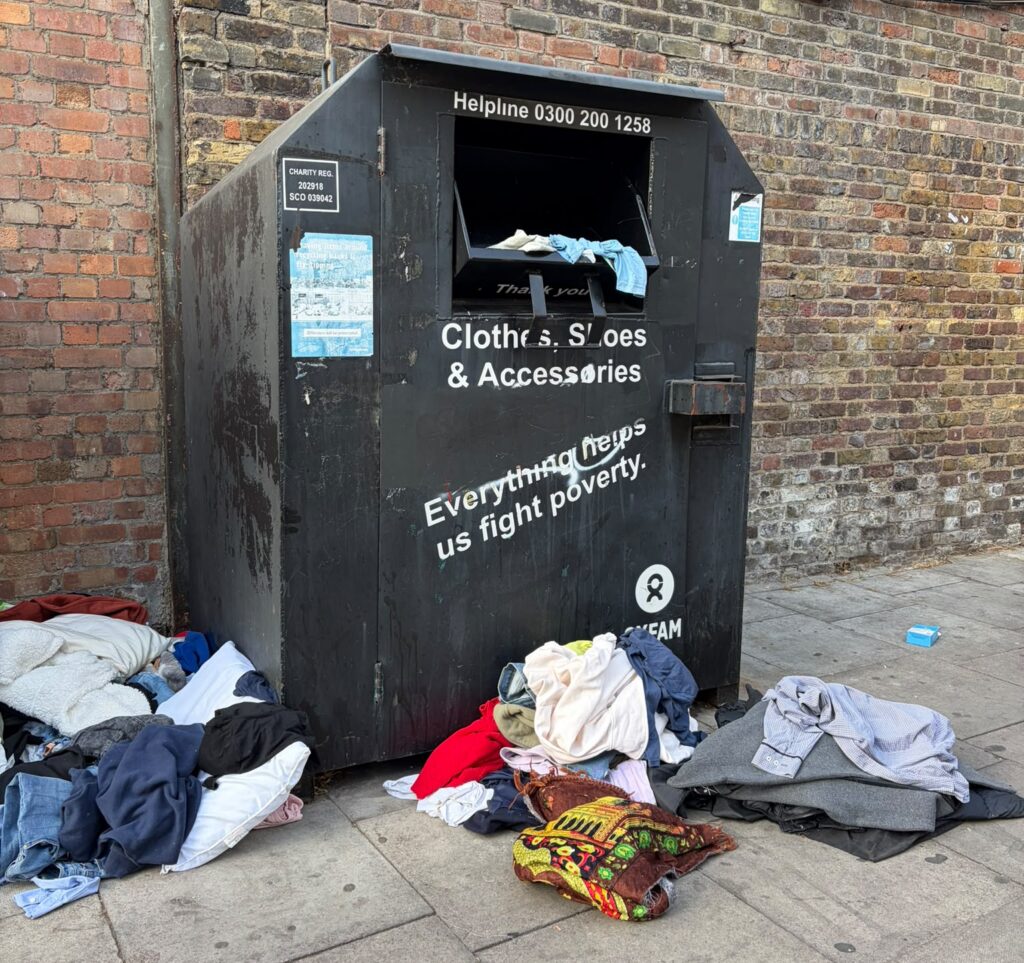
The Salvation Army Trading Company (SATCoL) told letsrecycle.com that its figures are up at least 16% and are expected to rise further before the end of the year. This equates to approximately 3,000 additional incidents this year.
The company’s fly tipping expenditure is projected to exceed £1 million this year.
The trading arm of the Salvation Army is not the only group effected, Oxfam confirmed it has also seen fly tipping increase alongside national trends.
Julie Tyrrell, Head of eCommerce and Retail Sustainability at Oxfam, said: “We are extremely grateful for donations, however we ask that people refrain from leaving them outside our banks when they are full, as they risk being damaged by the weather or animals.
“Textiles banks raise thousands of pounds for Oxfam’s work fighting poverty around the world but items which are damaged may not be able to be reused or recycled.
“Fly tipping is an ongoing problem and we have seen an increase in the number of fly tipping incidences at banks and the clearance of these incidences cost charities to remove.”
The charity advised that members of the public can request a free postal donation bag or donate directly to its stores.
The problem is a result of the wider issues facing the second-hand textiles sector.
Earlier this year, SATCoL significantly reduced its collection contracts and textiles banks due to challenging market conditions.
Other merchants have sought to pick up these contracts, but ultimately the gap in the market has not been completely filled.
Difficulties in the second-hand textiles market
The second-hand textiles sector has faced tough economic conditions in recent years.
The industry is being flooded by “ultra-fast fashion” produced by brands like Shein and Temu which has reduced the quality of second-hand clothing while at the same time increasing supply.
Traditionally in the UK, textiles which charity shops cannot sell are traded to “collector, sorter and processor” merchants. The same is true for textiles dropped off at textiles banks, for example at recycling centres or outside supermarkets.
The clothing is then usually graded by quality to be sent for reuse in secondary markets in Africa and Asia.
Items which cannot be sold overseas are discarded as waste via landfill or incineration.
However, the low value of ultra-fast fashion items has undermined this system, with overseas exporters no longer as interested in low-grade textiles coming from the UK.
At the same time, end markets such as those in Eastern Europe and the Middle East have been disrupted due to ongoing geopolitical tensions, including the ongoing Iran-US conflict.
Most recently, the Environment Agency introduced strict new rules around the export of used textiles, meaning merchants are having to dedicate extra resources to sorting processes.
The situation has seen textiles merchants cutting prices across the sector, including the implementation of gate fees for Household Waste Recycling Centre (HWRC) collections – which tend to be the lowest quality.
The British Heart Foundation announced earlier this month that it would be closing approximately 150 stores to ensure its “commercial sustainability”.
View our more detailed textiles price index here.

Some companies recycle textiles in different ways, for example Edward Clay & Son in Ossett W Yorkshire: edwardclay.co.uk