

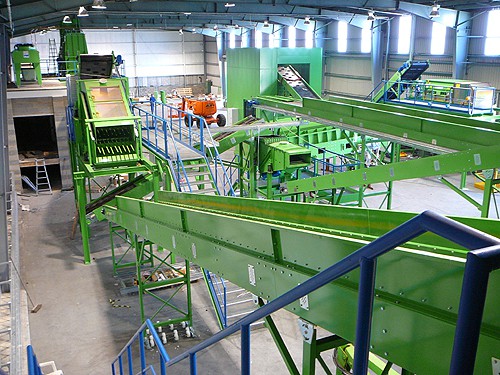
SWEEEP, which will now be known as SWEEEP/Kuusakoski, said that as a result of the agreement it would now be able to look at improving the cost, efficiencies and outputs from its Sittingbourne WEEE reprocessing facility, and to attract new customers by setting a new “benchmark” for WEEE reprocessing in the UK.
SWEEEP was set up three years ago and has invested more than £6.5 million in its Sittingbourne facility which offers up to 80,000 tonnes of reprocessing capacity a year across two plants – one dealing with all types of WEEE, excluding fridges, and the other handling cathode ray tubes (CRTs) from TVs.
Speaking to letsrecycle.com today about the two companies' decision to establish the joint venture, SWEEEP's managing director, Patrick Watts, said that Kuusakoski were “very innovative as far as getting the most out of waste electronics in terms of ferrous and non-ferrous metals”.
He also pointed towards their “tremendous experience” and “good relationship with end users of commodities” as strong points in favour of the Finnish company, which, prior to this joint venture has only had a UK presence in Sheffield, where it recycles stainless steel.
Mr Watts also stressed Kuusakoski's “ethical approach” to recycling, and added: “It's a philosophy they saw in us when they targeted us at a time when we were looking for a joint owner to take potential investments forward quickly.”
Commenting on the benefits of the deal from Kuusakoski's point of view, the company's managing director, Timo Kussakoski, said: “SWEEEP is one of the UK's leading WEEE organisations and we see in the team a perfect fit with our own aspirations in the UK marketplace.
“As a result of this venture, we're now able to offer a truly pan-European solution,” he added.

The benchmark in the UK is about to be raised
Patrick Watts, managing director, SWEEEP
This sentiment was echoed by Mr Watts who explained that, while business-to-business WEEE currently represented around 20% of SWEEEP's customers – with the other 80% coming from producer compliance schemes and household waste sites – it could now look to increase this aspect of its operations.
“Our customers are delighted with it and all of a sudden we can start talking about European contracts and not just UK contracts on the bigger B2B customers,” he said.
Next steps
Commenting on the next steps for the joint venture, Mr Watts said that the company would look at refining the processes it used to allow it to “substantially” increase the value of the materials it recovered during the WEEE reprocessing process by taking on board Kuusakoski's approach.
“We will be looking at future refinement of our output, we sort out stainless steel, they sort out the various grades, we sort out aluminium as a particular type, Zorba, they go beyond that and sort out cast aluminium from extracted aluminium,” he said.
“We're also looking at further refinement from plastics, at the moment they're very clean and exportable but we could presort out the various polymers,” he added.
And, while not able to provide exact detail on changes that could be made, he said: “We're now going forward, whatever investments are needed will now be carried out, whether that be acquisitions or plant”, adding that “the benchmark in the UK is about to be raised”.

Register for free to comment