



The Avonmouth Renewable Energy Plant will use a combination of gasification, pyrolysis and oxidation to treat up to 30,000 tonnes of non-recyclable waste produced by Bristol city council, and it is hoped the plant will be operational by the end of 2008.
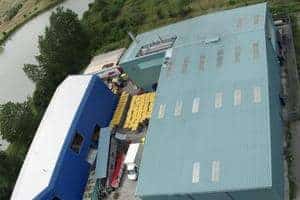
Construction of the plant had been delayed after original developers, Compact Power, went into administration in September 2007, but work on the facility, which will be able to produce 2.5 megawatts of electricity, is now due to progress.
Nick Story, project consultant for Ethos, told letsrecycle.com: “We are in the process of getting the civil engineering work underway. We have lost a bit of time but we are hoping to catch up in the next couple of months.”
Avonmouth
Ethos – formerly skip hire firm Sweeney Environmental – purchased the project, and with it the £5million of Defra funding acquired by Compact Power, in January this year (see letsrecycle.com story). Uxbridge-based Ethos explained that it would combine the pyrolysis technology it had acquired from Compact Power and subsidiary BATNEEC (Bristol) with its own existing bio-drying technology.
The technology works by heating waste at a high temperature in an oxygen free chamber, which converts waste to simple gases and carbon char. The carbon is then also converted to gas and the resulting gases are combusted to produce heat, which is then converted to energy as steam. According to Defra, the process generates low levels of emissions, while also generating electricity.
Mr Story said: “Because it is a Demonstrator Programme there are always new issues to be resolved but we are hoping to get the construction underway of the plan within the next few weeks. I think we will be able to provide a whole set of Demonstrator results.”
Sponsorship
Originally, ninety projects applied to receive government sponsorship for the development of facilities that would be home to new-to-market technologies, with 10 being successful.
However, in August last year, Australian-owned Novera Energy had to pull-out of developing a facility that would annually convert 90,000 tonnes of residual waste into electricity following “significant delays” in obtaining planning permission (see letsrecycle.com story).
But the Defra project has achieved success, with the development of the Avonmouth plant coming hot-on-the-heels of the Merseyside Waste Disposal Authority opening its £13 million mechanical biological treatment facility in Knowsley at the end of June 2008 (see letsrecycle.com story).
The facility – which is being subjected to a succession strategy to plan for its use following the end of the Demonstrator Programme – is capable of processing 50,000 tonnes of municipal waste from the surrounding area and will play an important role in waste management before the Merseyside Waste Disposal Authority's £3 billion waste PFI contract becomes operational.
Also recently, Energos' gasification plant on the Isle of Wight – which received £2.7 million in Defra funding – became the first its kind to receive preliminary Renewable Obligation Certificate (ROC) accreditation (see letsrecycle.com story).
So far the only project to reach the end of its Demonstrator life is Bioganix's aerobic digestion facility in Leominster, Herefordshire. The plant was capable of processing 10,000 tonnes of source separated garden waste, kitchen waste, other food waste and biodegradable municipal waste into composted fertiliser, and will now close at the end of the year due to the finite contract signed as part of the programme.
Speaking to letsrecycle.com, Nick Helme, managing director of Bioganix, said: “It has been of considerable use, we have refined and developed a technology. We have proved the value and use of composted fertiliser products.”
Defra
Having put £30 million worth of funding into the scheme, Defra was keen to highlight that it did not expect to see any immediate results but conceived the programme in 2003 as a means of finding new and innovative technologies that were also economical, socially and environmental viable.
A Defra spokeswoman said: “It is all long term stuff. The whole point of it is that we learn from it. We are not going to be expanding our views.
“Even with the Novera plant there are things to learn from it – why did that happen, what could have been done differently – there are always lessons to be learned,” she added.

Register for free to comment